

A tender comes in for a four-lane highway. The spec mainly requires "200 W solar street light, 30,000 lumens". Three suppliers quote. One is half the price of another. The cheap lamp turns on every night in the first month, so nobody complains. Two winters later the road is dark in patches and the battery is dead.
Highways punish shortcuts because the margin is thin everywhere: the road is wide, the poles are tall, the standards are strict, and one failed lamp leaves a gap in a line of lights that drivers read at 100 km/h. This guide follows the order an engineer would use: first the light the road needs, then the watts to make it, then the battery and panel to carry those watts through the worst week of the year.
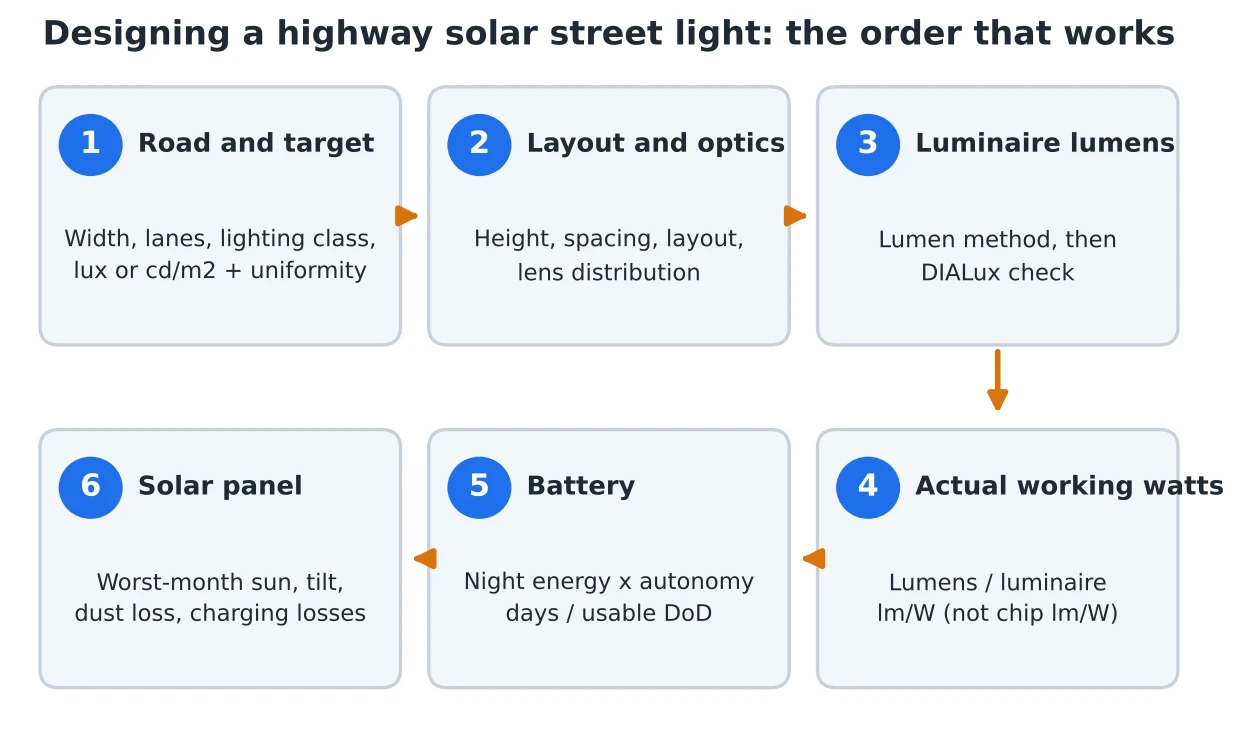
Figure 1. The design order. Each step feeds the next, so a mistake in step 1 or 4 is carried into the battery and panel.
1. Start with the road, not the lumens
Highway lighting standards are strict, and they are not written in lumens. They are written as light on the road surface (illuminance, in lux) or as brightness seen by the driver (luminance, in cd/m²), plus how evenly that light is spread.
Take example in Europe, EN 13201-2 sorts roads into M classes: M1 asks for 2.00 cd/m² average with overall uniformity of at least 0.40, M2 asks for 1.50 and M3 for 1.00 [2]. Which class applies is set by the road contractor, not by the lamp supplier.
Why lumens alone fail: a luminaire with a lot of lumens and a poor light distribution can light the shoulder and the sky and leave the middle lane patchy. The standards measure the road, so the design starts from the road.
1.1 Light distribution, pole height and spacing
The light distribution curve (the photometric file, usually an IES file) tells you where the luminaire sends its light. North American practice sorts distributions into IES Types I to V, the spacing you can actually use depends on the lumens and the distribution of the lamp you chose.
The practical order is:
Read the road. Carriageway width, number of lanes, shoulder, median, and whether poles go on the median, the shoulder or both sides.
Pick the layout. A median pole with two arms covers both carriageways from one pole. Opposite or staggered poles suit separated carriageways or very wide roads.
Pick mounting height and arm. Taller poles spread light over more width and cut glare, but need more lumens per luminaire.
Pick the distribution lens. The lens should throw light across all lanes and the shoulder, and cut off above the driver's line of sight.
Calculate, then simulate. Use the lumen method for a first spacing, then check uniformity and glare with an IES file in DIALux or a similar tool.
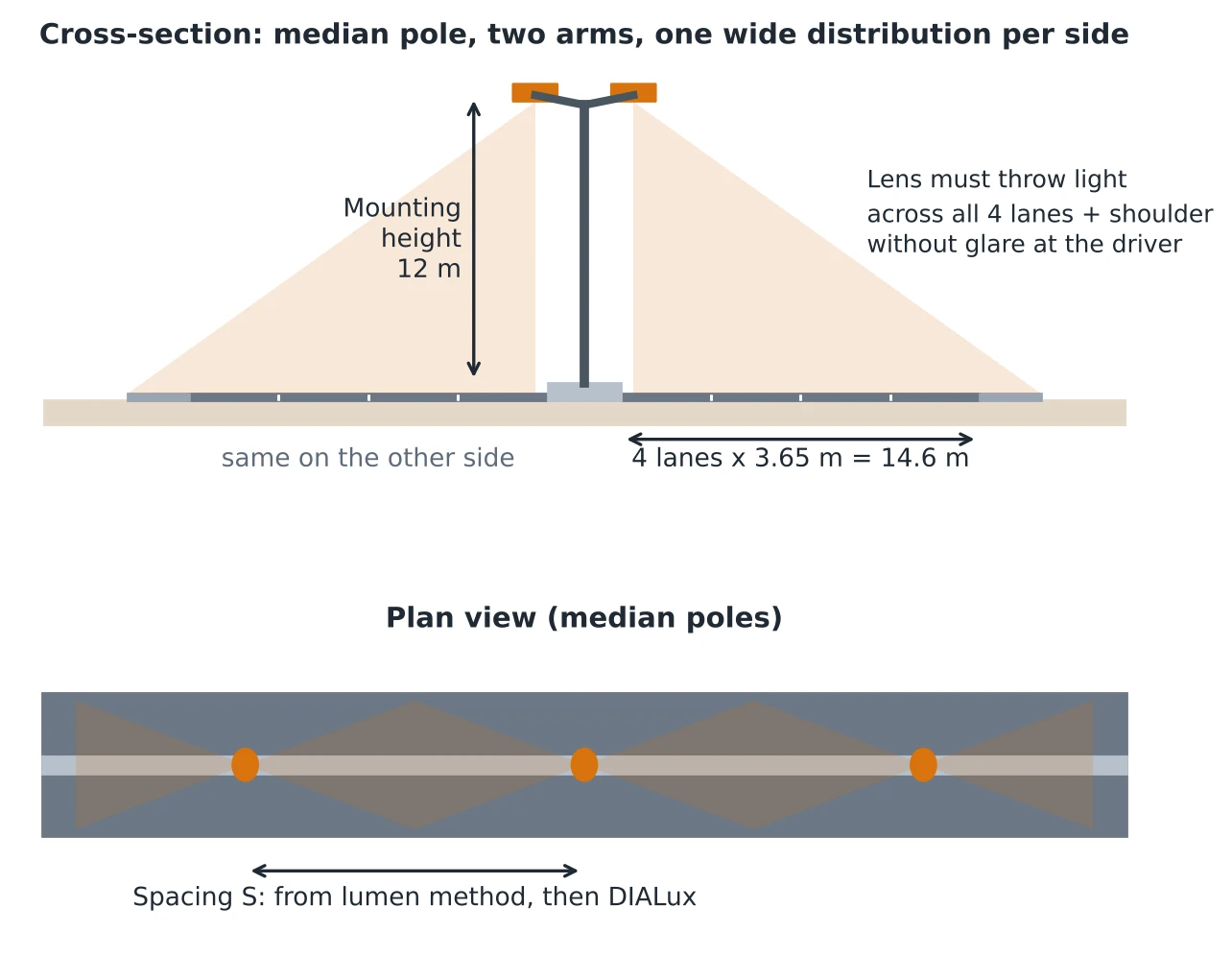
Figure 2. Example layout used in this article: median pole, 12 m mounting height, two 24,000 lm luminaires, 4 lanes of 3.65 m per carriageway. A schematic, not a drawing for construction.
1.2 A quick rule: pole spacing from the beam angle
For a first layout you don't need the full lumen method. The beam angle gives a simple geometric estimate. A luminaire at height H lights the road along its length out to an angle θ from straight down, so the ground it reaches on each side is H × tan θ. Two neighbouring lights should overlap, so the spacing is S = 2 × H × tan θ.
The catch is that you can't use the full beam angle. A beam angle is where intensity drops to half, and light on a flat road also falls off quickly at wide angles (roughly with the cube of the cosine of the angle from vertical). Using the full angle gives very large spacings: a 150° beam (75° each side) would suggest 2 × tan 75° = 7.5 times the height, which leaves dark patches between poles. In practice the useful angle is about 55° to 65° from vertical, and that gives the rule many solar street light makers use: pole spacing of about 3 to 4 times the pole height.
|
Spacing S |
Angle to the mid-point |
Mid-point light vs under a pole |
Max/min along the road |
|
2.5 × H |
51° |
about 47% |
about 2.1 : 1 |
|
3 × H |
56° |
about 34% |
about 2.9 : 1 |
|
3.5 × H |
60° |
about 25% |
about 4.0 : 1 |
|
4 × H |
63° |
about 18% |
about 5.5 : 1 |
|
4.5 × H |
66° |
about 13% |
about 7.3 : 1 |
Calculated here for a single line of identical point sources at height H, assuming the lens gives equal intensity at all angles up to about 70° from vertical and ignoring road width. A real wide-angle lens puts more light at high angles, which helps uniformity; a narrow lens does worse. Check any layout with an IES file.
2. From target light to real working watts
Once you know the lumens each luminaire must deliver, the watts follow from efficacy: lumens ÷ lm/W = watts. This is where solar street lights often go wrong, because the number on the nameplate is frequently not the power the lamp draws at work.
Reasons are easy to find. A "200 W" label may be the sum of the chip ratings, the maximum controller output, or the panel size, not the electrical power of the luminaire at its working current. Many solar lights also run on a dimming profile, so the average power over the night is lower than the peak. Ask for three numbers on one line: lumens out of the luminaire, working watts at that output, and the resulting lm/W. If a supplier can't give the working watts, the battery and panel in the quote can't be checked either.
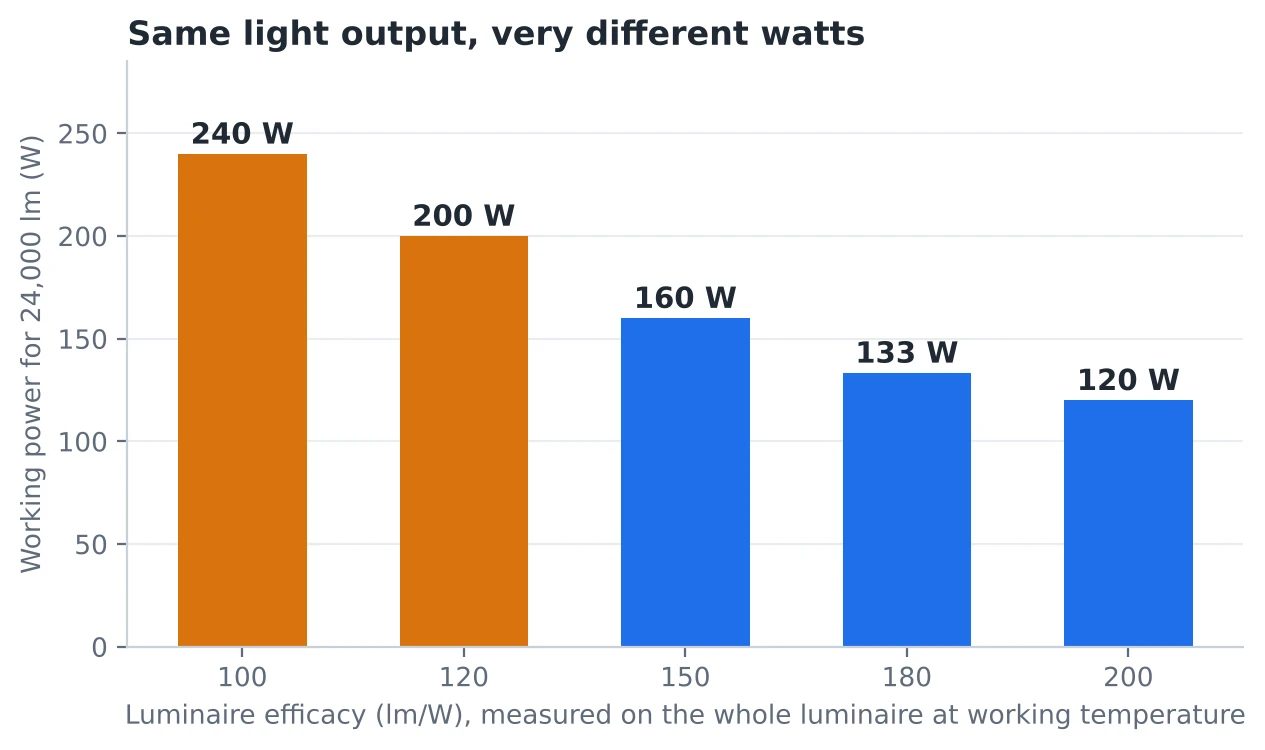
Figure 3. Working power needed to produce 24,000 lm at different luminaire efficacies. Calculated: watts = lumens ÷ lm/W.
Figure 3 shows the effect. For the same 24,000 lm, a luminaire at 100 lm/W needs 240 W and one at 200 lm/W needs 120 W. Every watt you save is also a watt of battery and panel you don't have to buy. It also cuts both ways: a lamp that claims 24,000 lm from 120 W but really delivers 100 lm/W is giving 12,000 lm, and the road is half as bright as the design assumed.
3. Luminaire efficacy and heat
3.1 Use the luminaire's efficacy, not the chip's
LED chip catalogs quote efficacy at a low current and a cool junction, with nothing in front of the light. A luminaire has a lens or cover that absorbs some of it, a driver that wastes some power, and a working temperature that is higher than the datasheet test point. The number that matters for design is the lm/W of the complete luminaire, measured at its working power and temperature. Ask for the photometric report for the whole luminaire.
3.2 Lumen maintenance: what "50,000 hours at 80%" means
LEDs rarely just switch off. They dim. Lumen maintenance is how much of the original light is left after a given time; L80 at 50,000 hours means 80% of the initial light remains at 50,000 hours. Practical buyers often use L80 at 50,000 hours as a target for roadway luminaires.
3.3 Heat design decides whether the target is met
An LED turns most of its input power into heat. If the heat can't leave, the junction runs hot and the light fades faster. Narendran and colleagues measured this on white LEDs in 2004: across junction temperatures from 69 °C to 115 °C the decay constant grew exponentially with temperature, and much of the light loss came from yellowing of the encapsulant [3]. Their conclusion was to pull heat from the die more efficiently.
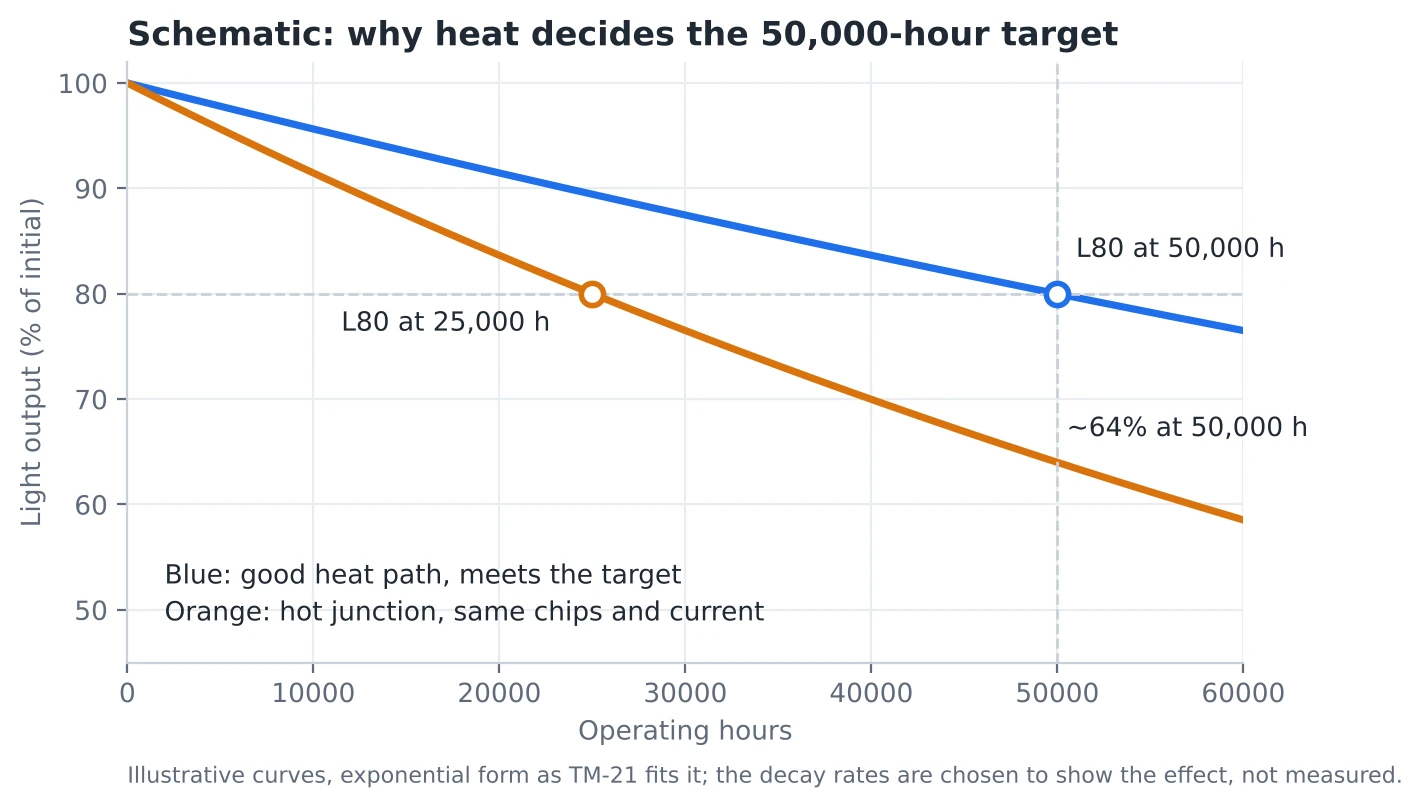
Figure 4. Schematic only. Same chips, same current: the cooler design reaches L80 at 50,000 h, a hotter one at 25,000 h and falls to about 64% by 50,000 h.
The heat path runs from the LED die through the board (usually aluminum), the interface to the housing, the housing and its fins, and then into the air. A weak link anywhere raises the junction temperature at the same power. Some factories simply add more LEDs to hit a lumen number and ignore this path. More chips can actually help heat if the power is spread over more area, so the chip count isn't the problem. The problem is a housing too small or too thin, a poor thermal contact, or no thermal data at all. DOE's guidance mentions an in-situ temperature measurement test that records the LED temperature inside the luminaire [4]. Ask for the case temperature at full power after the lamp has warmed up, at a stated ambient.
None of this shows in a lumen figure. A hot luminaire can have the same initial lumens as a cool one and lose a third more light by year five.
4. Battery: size it, then choose 25.6 V
4.1 Size from the work mode, autonomy and hours
Battery energy comes from three inputs: how much the lamp uses per night (work mode and hours), how many nights it must run without sun (autonomy), and how much of the battery you can use (depth of discharge). The calculation is: nightly energy × autonomy nights ÷ usable depth of discharge.
Example, labeled as an assumption: a 120 W luminaire on a dimming profile that works out to 7.2 full-power equivalent hours per night uses 864 Wh a night. Two nights of autonomy is 1,728 Wh of usable energy, and three nights is 2,592 Wh.
4.2 Why 25.6 V is the sensible system voltage for highway lights
The same power at a lower voltage means more current. For a 100 W load, current is about 3.9 A at 25.6 V, 7.8 A at 12.8 V and 31.3 A at 3.2 V.
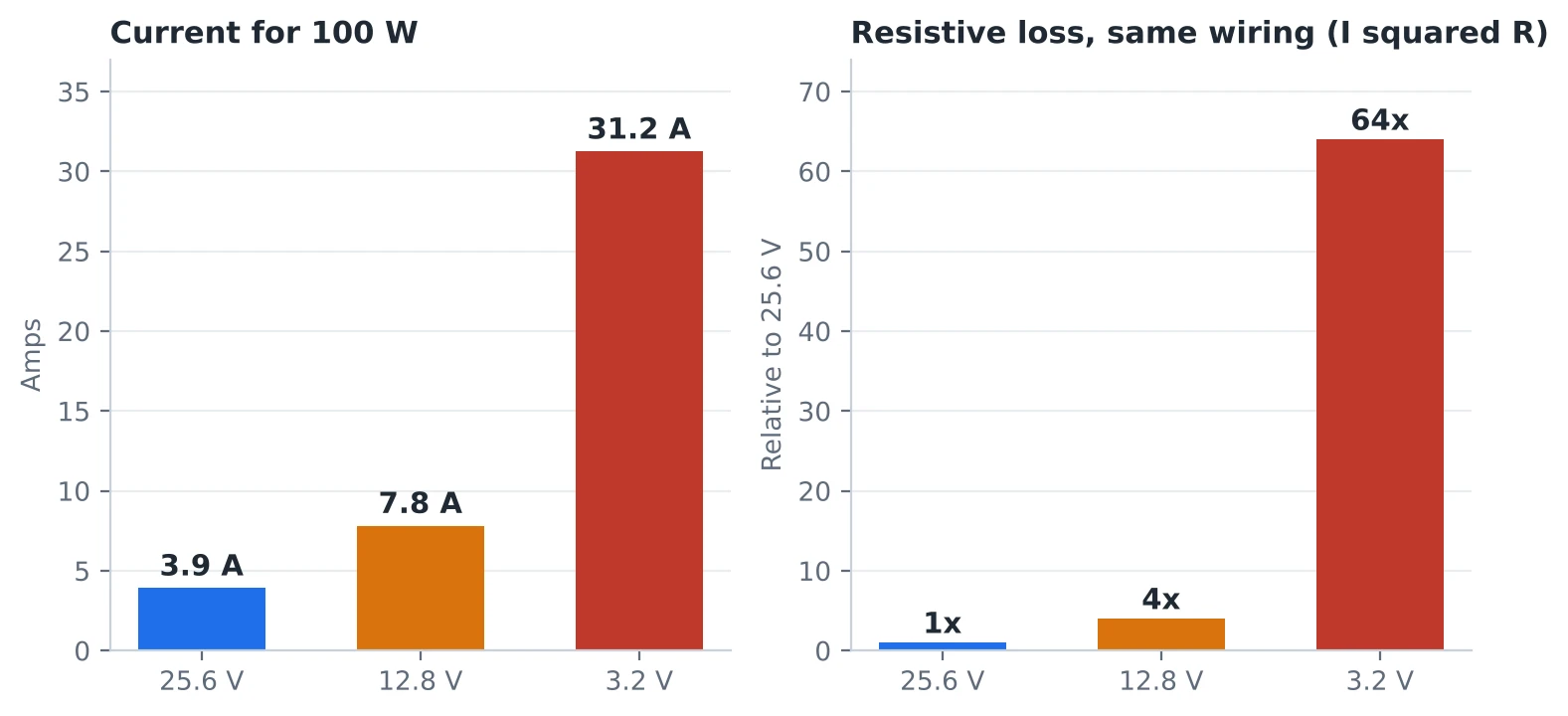
Figure 5. Current for a 100 W load by system voltage, and resistive loss relative to 25.6 V on the same wiring (loss scales with current squared).
Resistive loss in wires, connectors, fuses and the battery's own internal resistance goes with current squared (I²R). Twice the current means four times the loss, which is the argument often made for higher-voltage systems [4]. In our example: 12.8 V has 4× the loss of 25.6 V and 3.2 V has 64×. Lower current means less loss, less heat in the pack and the wiring, less stress on the battery and a longer life.
A 3.2 V system is one LiFePO4 cell, or a few in parallel. It can run a very small lamp but not a highway luminaire: at the currents involved, the wiring would need to be thick and every connection becomes a heat source. Highway-class lights should use 25.6 V (eight LiFePO4 cells in series) or higher. That is a design recommendation, not a standard requirement.
5. Solar panel: size for the worst season, then add dust
The panel has to refill the battery in the worst month of the year, not the average. Use the sunshine hours (or kWh/kWp/day) of the shortest-sun season, then add the losses between the panel and the battery.
For Example, the sun data below is the Rouiba profile (Algiers area, Algeria) from profilesolar, which uses NASA POWER data [6]: winter 3.21 kWh/kWp/day, autumn 4.22, spring 6.17 and summer 7.49. I use it as a representative location, not as the exact site of any project.
Using the 864 Wh nightly load and an assumed 0.85 charging-chain efficiency (panel to controller to battery), the clean winter panel size is 864 ÷ (3.21 × 0.85) = 317 Wp. That only refills one night's use per day. After cloudy days the panel also has to recharge the battery, so a real design adds margin or uses a longer recharge window.
5.1 Tilt
Tilt moves the best production toward the season you design for. A steeper tilt favors winter sun, a flatter one favors summer. For a worst-month design, tilt the panel for winter, as long as it doesn't hurt self-cleaning from rain, and use the local latitude and a tool such as PVGIS or NASA POWER to check the effect.
5.2 Dust
Dust and sand can cut panel output sharply. In a 2024 study in PLoS One, Hameed and colleagues reported power losses of 37%, 33% and 23% under the dust conditions they tested [5]. Losses depend heavily on place and rain, so use that as a warning, not as a forecast.
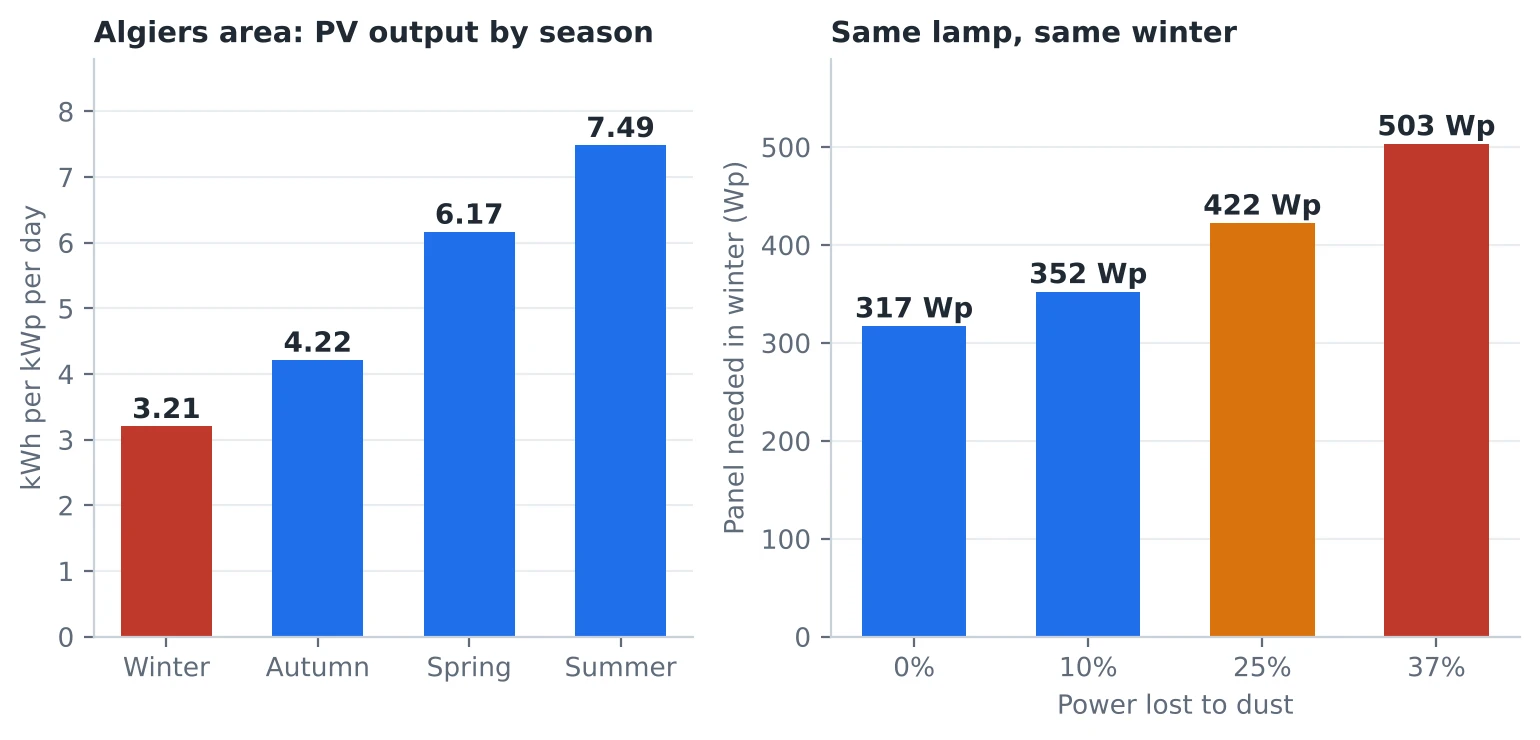
Figure 6. Left: PV output by season for the Algiers area (NASA POWER via profilesolar [6]). Right: the winter panel size for the 864 Wh/night example as dust loss grows; 0.85 charging efficiency assumed.
The right chart shows the price of ignoring dust. The same lamp needs 317 Wp clean, 352 Wp at 10% loss, 422 Wp at 25% and 503 Wp at 37%. Either you oversize the panel or you clean it. In sandy, dusty regions self-cleaning solar street lights are worth considering, since cleaning a pole at 12 m by crane on a highway is expensive and closes lanes.
6. Where Suntisolar fits
Suntisolar (Yantai Xutai New Energy Technology Co., Ltd.) lists solar street lights up to 240 W, and the models with a stated battery use cylindrical LiFePO4 at 25.6 V. For the larger models, the listed batteries are:
|
Model (as listed) |
Power |
Battery (LiFePO4) |
Battery energy (V x Ah) |
|
XT1968SELD200-D5 |
200 W |
25.6 V 60 Ah |
1,536 Wh |
|
XT2358SELD220-D5 |
220 W |
25.6 V 75 Ah |
1,920 Wh |
|
XT2648SELD240-D5 |
240 W |
25.6 V 90 Ah |
2,304 Wh |
As listed on suntisolar.com [7], accessed November 2026;.
7. Checklist before you place a highway order
Road data: width, lanes, lighting class or target lux/cd/m², and uniformity targets.
Photometric file (IES) and a DIALux or equivalent simulation for your pole height and spacing.
Lumens, working watts and whole-luminaire lm/W, written on one line, at working temperature.
Lumen maintenance: the LM-80/TM-21 data for the chip, the case temperature at full power, and the lumen maintenance you require (for example L80 at 50,000 h, agreed in the contract).
Battery: system voltage (25.6 V or higher), cell type and maker, usable energy, autonomy days, depth of discharge, and temperature behavior.
Panel: Wp, tilt, the sun-hours figure and source used, the dust loss assumed, and the cleaning plan or self-cleaning design.
Warranty and test reports for the battery, luminaire and controller.
Frequently asked questions
How many lumens does a highway solar street light need?
There is no single number. It depends on the road class, mounting height, spacing and the distribution lens. Work from the target lux or cd/m² and uniformity, then calculate and simulate [1][3].
Why is the nameplate wattage not enough?
The label may be a chip total or a maximum, not the working power. Lumens, working watts and lm/W should be stated together, so the battery and panel can be checked against them.
Is L80 at 50,000 hours an international standard?
Yes This standard comes from IES TM-21.
Why use 25.6 V instead of 12.8 V?
At the same power, 12.8 V draws twice the current and has four times the resistive loss, which means more heat and stress on the pack and wiring [4]. It is a design preference, not a rule.
Do I need self-cleaning panels?
In sandy or dusty regions with little rain, dust can cost a large share of output [5], and cleaning poles on a highway is costly. Self-cleaning designs are worth considering there.
Bottom line
For a highway, work backwards from the road: standard, layout, distribution, lumens, working watts, then battery and panel. Ask for working watts and whole-luminaire efficacy, ask how the lamp is cooled, use 25.6 V or higher, and size the panel for the worst month with dust included. A quote that skips these will look cheap until the second winter.
This article is general information, not engineering advice. Calculations use stated assumptions and are not field measurements. Standards and product specifications change, so confirm current versions before specifying.
References
[1] TxDOT Highway Illumination Manual: illuminance and luminance design values for continuous lighting (AASHTO Roadway Lighting Design Guide, Table 3-5a). https://www.txdot.gov/manuals/trf/hwi/lighting_design_and_layout/illumination_levels-i1004163/illuminance_and_luminance_design_values_for_contin.html
[2] COST LONNE. EN 13201 explained (M classes). https://cost-lonne.eu/solutions/en-13201-explained/
[3] Narendran, N., Gu, Y., Freyssinier, J.P., Yu, H., Deng, L. (2004). Solid-state lighting: failure analysis of white LEDs. Journal of Crystal Growth, 268(3-4), 449-456. https://www.lrc.rpi.edu/programs/solidstate/pdf/narendran2004_jcrystalgrowth.pdf
[4] Mouser. Adding 48V to 12V means major benefits (I²R loss). https://resources.mouser.com/ev-hev/adding-48v-to-12v-means-major-benefits
[5] Hameed et al. (2024). Dust effects on photovoltaic performance. PLoS One. https://pmc.ncbi.nlm.nih.gov/articles/PMC11521312/
[6] profilesolar. Solar profile for Rouiba, Algeria (NASA POWER data). https://profilesolar.com/locations/Algeria/Rouiba/
[7] Suntisolar. Solar street light product listing, accessed November 2026. https://www.suntisolar.com/solar-street-light/
[8] Suntisolar. Self-cleaning solar street light. https://www.suntisolar.com/solar-street-light/self-cleaning-solar-street-light/
[9] Suntisolar. Highway project. https://www.suntisolar.com/high-way-project


