

When should you save energy with sensing - and when should you size the system for all-night lighting?
The real reason solar street lights use motion sensors
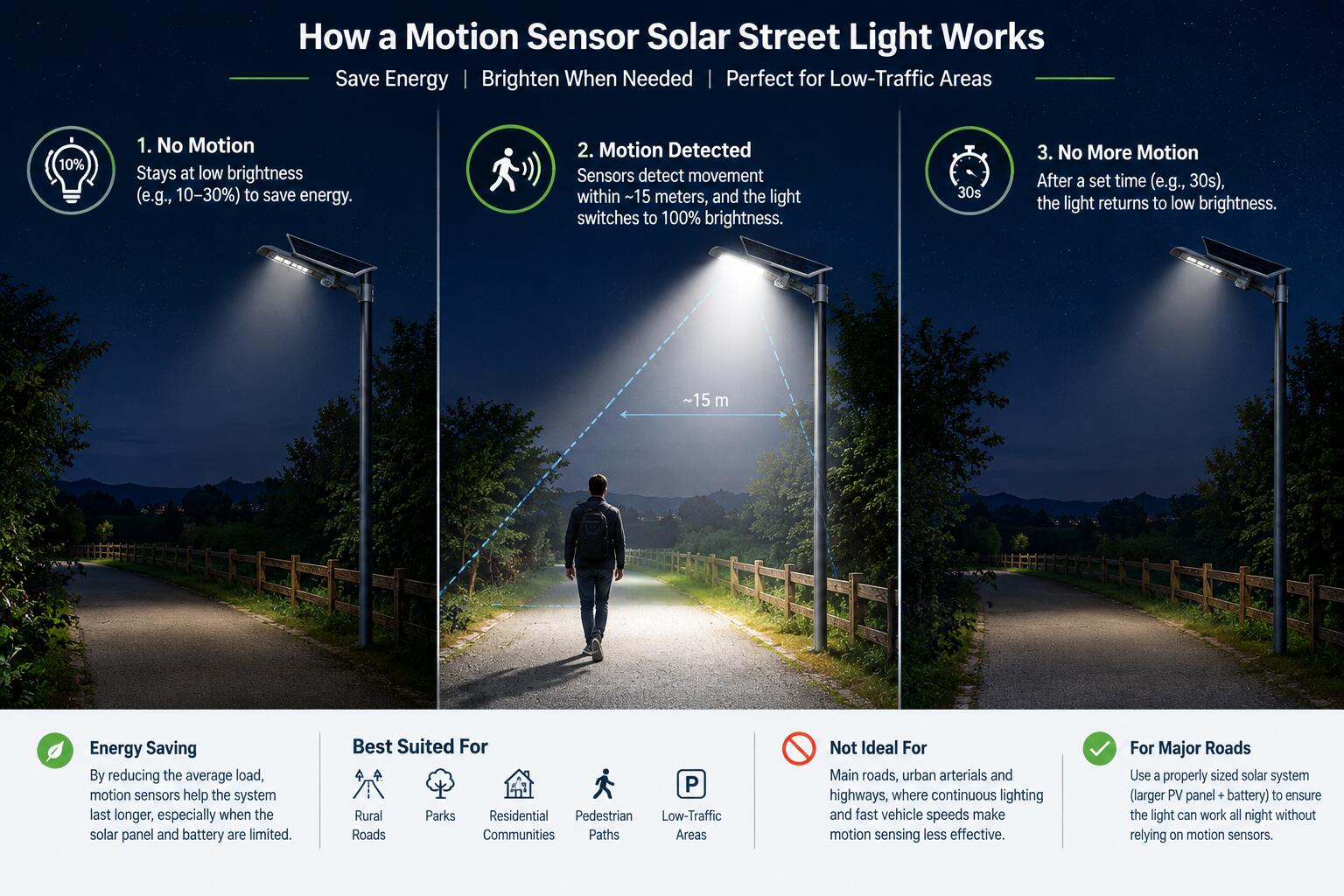
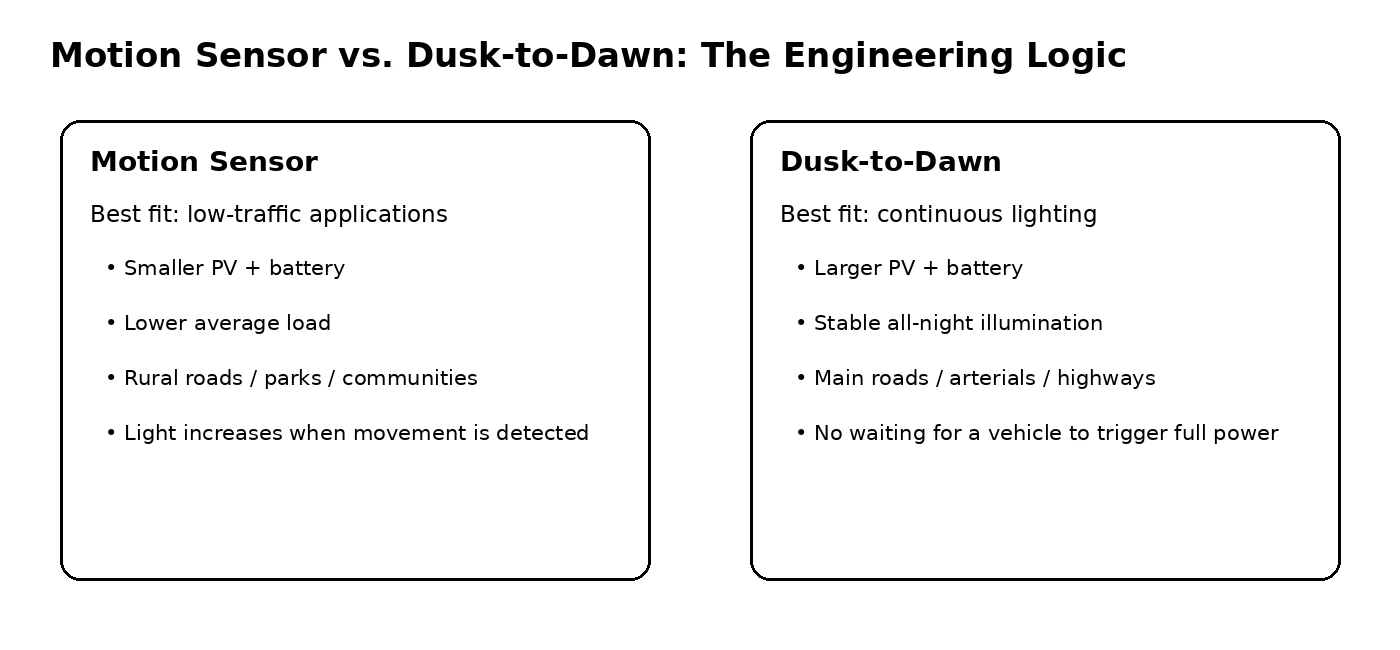
Motion sensing is often presented as a smart-lighting feature. In solar street lighting, however, the practical reason is usually much simpler: saving energy. If the photovoltaic panel and battery are relatively small, running the lamp at full output from dusk to dawn may use more energy than the system can reliably replace and store. A motion sensor reduces the average load by keeping the lamp at a lower level when there is no traffic and increasing the light when a vehicle or pedestrian is detected.
That makes motion sensing useful when the solar system has to work within a tight energy budget. It is not automatically the right choice simply because a sensor is available.
Motion sensing is mainly an energy-management strategy
Think about the system as an energy balance. Every night, the lamp consumes energy, while the PV module has to put enough energy back into the battery during the day. If the available solar generation and battery capacity are limited, reducing the lamp's average nighttime power can make the difference between a system that survives the night and one that runs out of energy before dawn.
In simple terms:
- Smaller PV + smaller battery → higher need for load reduction.
- Lower average lamp power → longer usable nighttime operation.
- Motion sensing → one way to reduce average energy consumption.
- Properly sized PV + battery → less need to depend on motion sensing.
Where motion-sensor solar street lights make sense
Motion sensing is a natural fit for places where people or vehicles are present only occasionally. The light does not necessarily need to stay at full output when nobody is using the road or space.
Rural roads
Traffic can be sparse for long periods at night. A lower standby level with higher output when a vehicle approaches can be a practical way to reduce energy consumption.
Parks and pedestrian paths
There may be long periods with little or no activity. Motion-based lighting can keep the system quiet on energy use while still providing higher illumination when people enter the area.
Residential communities
Traffic is usually intermittent rather than continuous. Motion control can work well where the lighting requirement allows a lower background level between movements.
Why major roads are a different problem
City arterial roads and highways have a different lighting requirement. The question is not only how much energy the lamp uses. It is also when the required light level becomes available.
Many standalone motion sensors used on solar street lights have a practical detection range around 15 m, although the actual range depends on the sensor, mounting position, lens, vehicle size, speed and site conditions. Now imagine a lamp mounted on a 10 m pole along a road. If a vehicle is travelling quickly, it may enter the effective detection area only a short time before reaching the pole. The lamp can switch to full power, but the timing may be later than what you would want on a road that requires continuous, predictable illumination.
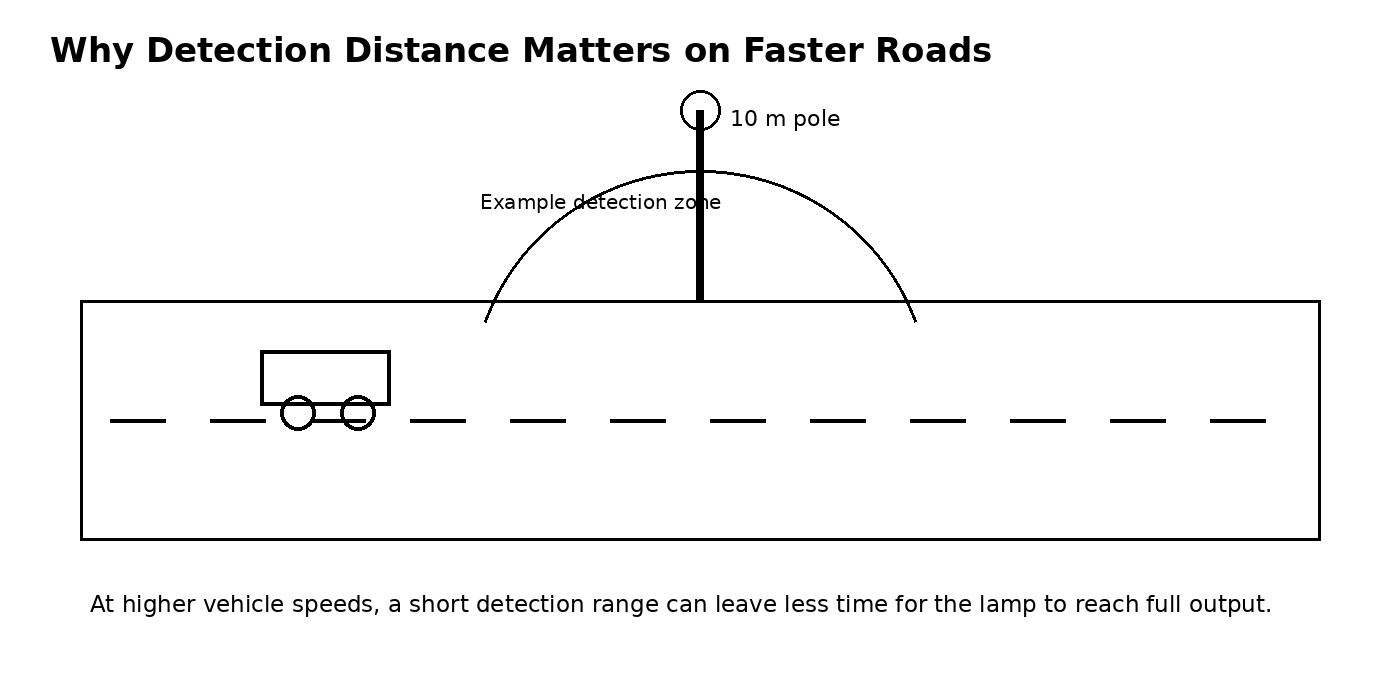
Figure 2. A short detection distance becomes more important as vehicle speed increases.
The key point: detection distance is not the same as lighting coverage
A sensor can detect a vehicle only after that vehicle enters its detection zone. That is different from designing the road so that the required lighting level is already available along the road. For low-speed, low-traffic locations this difference may be acceptable. On a busy arterial road or highway, it can become an undesirable operating characteristic.
For major roads, size the solar system first
If a road needs effective lighting throughout the night, the first engineering question should be whether the PV and battery system is large enough to deliver it. That means looking at lamp power, operating hours, local solar irradiation, battery usable capacity, system losses, temperature effects and the required autonomy.
Once the system is correctly sized, dusk-to-dawn operation can provide predictable illumination without waiting for traffic to trigger the lamp. Motion sensing can still be used where the lighting design and road classification allow it, but it should not be used simply to compensate for an undersized solar system on a road that requires continuous lighting.
Three simple examples
|
Application |
Typical night pattern |
Practical approach |
Why |
|
Rural road |
Low and intermittent traffic |
Motion sensing can be considered |
Long periods with little traffic make energy saving useful |
|
Urban arterial road |
Frequent and relatively continuous traffic |
Dusk-to-dawn / properly sized system |
Predictable lighting is more important than waiting for a vehicle |
|
Highway |
Higher vehicle speed and continuous movement |
Dusk-to-dawn / properly sized system |
Short detection windows are less suitable for the main lighting function |
What does the research say?
A useful field study is Pasolini et al., published in Sensors in 2024. The researchers compared several adaptive street-lighting strategies using real traffic data and operational installations in Italy and Vietnam. The study is important here because it did not treat motion sensing as universally superior: its measured performance depended on the road, traffic conditions and control strategy.
In the study's 463-day observation of an M3 road in Cesena, the reference 100 W streetlight consumed 549.4 kWh under an astronomical-clock strategy and 415.0 kWh with a 1-minute motion-sensing strategy. On an M4 road in Biassono, 115 days of data showed 135.9 kWh for the astronomical-clock case and 121.5 kWh with 1-minute motion sensing. These are site-specific measurements, not a universal saving percentage.
More importantly, the same study found that its Full Adaptive Installation (FAI) approach could achieve larger savings than motion sensing in the monitored M3 and M4 cases. This supports a broader engineering lesson: the best control method depends on the road and the lighting requirement, rather than simply adding a motion sensor to every streetlight.
Research reference: Pasolini, G. et al. (2024). "Comprehensive Assessment of Context-Adaptive Street Lighting: Technical Aspects, Economic Insights, and Measurements from Large-Scale, Long-Term Implementations." Sensors, 24(18), 5942. DOI: 10.3390/s24185942.
How this applies to Suntisolar solar street lights
Suntisolar's approach for many road-lighting applications is to build enough PV and battery capacity into the system so the lamp can operate effectively through the night, rather than making motion sensing the only way to reduce energy consumption.
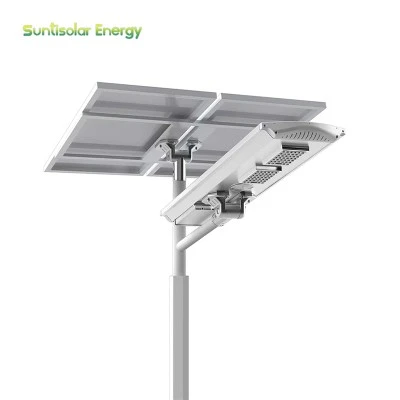
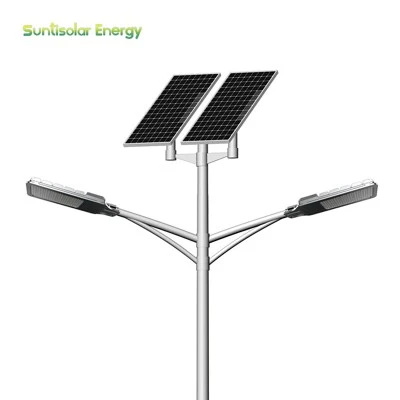
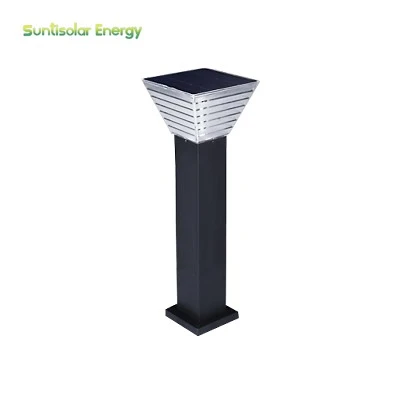
For example, Suntisolar's Z88 range is designed for higher-output applications, while the product portfolio also includes different configurations for branch roads, rural roads, parking areas and communities. The exact PV and battery configuration should always be selected against the site's solar resource, required lighting level, operating hours and autonomy.
For a major road, this leads to a simple design principle: if the project requires continuous lighting, use a sufficiently sized PV and battery system and let the luminaire operate as required. Do not reduce the lighting requirement just because the solar system is too small.
Motion sensor vs. dusk-to-dawn: a practical comparison
|
Factor |
Motion Sensor |
Dusk-to-Dawn |
|
Main purpose |
Reduce average energy use |
Provide predictable nighttime lighting |
|
Best fit |
Rural roads, parks, communities, low-traffic areas |
Urban roads, arterials, highways, continuous-use areas |
|
PV/battery requirement |
Can work with smaller energy budget |
Needs sufficient PV and battery capacity |
|
Traffic pattern |
Intermittent |
Continuous or unpredictable |
|
High-speed traffic |
Can create a short response window |
No trigger delay |
|
Design priority |
Energy saving |
Lighting availability and continuity |
The bottom line
Motion sensors have a clear job in solar street lighting: they reduce the average load when the road or space is not being used. That makes them especially useful when PV and battery capacity is limited and traffic is intermittent.
But a motion sensor should not be treated as a universal upgrade. On major urban roads and highways, where traffic is faster and lighting needs to be continuous, it is usually more important to size the PV panel and battery correctly so the lamp can provide the required light throughout the night.
That is the difference between using a sensor to compensate for limited energy capacity and designing a solar street light with enough energy capacity from the start.
FAQ
Are motion-sensor solar street lights more energy efficient?
They can reduce average energy consumption, but the actual benefit depends on traffic, sensor settings, dimming levels and the lighting strategy. They are not automatically the best option for every road.
Are motion sensors suitable for highways?
They are generally less attractive when the main lighting function requires continuous, predictable illumination and vehicles travel at higher speeds. The complete lighting design and applicable road standards should determine the control strategy.
Why are motion sensors common on rural solar street lights?
Rural roads often have long periods with little traffic, so reducing the lamp's output during those periods can save significant energy.
Can a solar street light work all night without a motion sensor?
Yes. If the PV array, battery, lamp power and operating schedule are properly matched to the local solar resource and required autonomy, the system can be designed for dusk-to-dawn operation.
Should I choose a motion sensor or a larger battery?
For a road that requires continuous lighting, the better engineering question is whether the complete PV-battery system is correctly sized. A sensor should not be used to hide an inadequate energy budget.
References and further reading
1. Pasolini, G. et al. (2024). Sensors 24(18), 5942. "Comprehensive Assessment of Context-Adaptive Street Lighting..." https://doi.org/10.3390/s24185942
2. Suntisolar Z88 120W product information: https://www.suntisolar.com/z88-120w-smd-specification-2.html


