
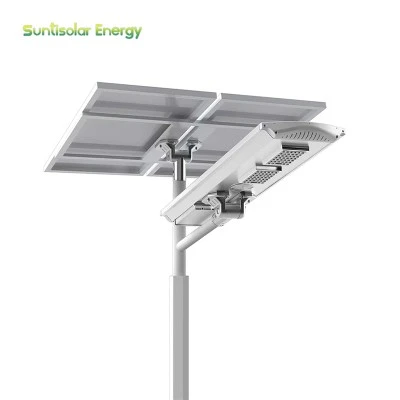
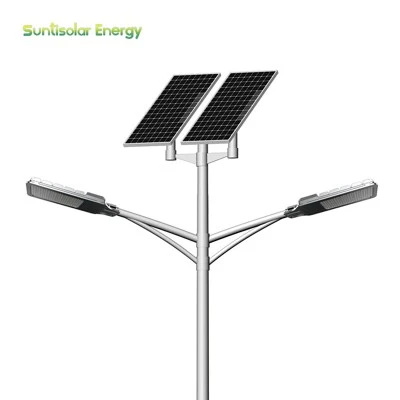
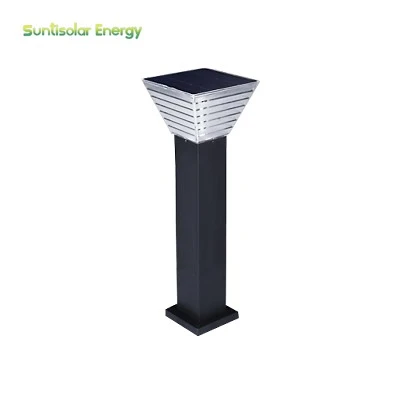

Ask most buyers what matters on a solar street light spec sheet, and lumens is usually the first number they look at. Fixtures get marketed at 5,000, 10,000, 20,000, even 30,000 lumens - and it's easy to assume the bigger figure automatically wins. In practice it doesn't work that way. The right lumen output for a project comes down to road width, pole height, spacing, beam pattern, LED quality, and the illuminance the road actually needs on its surface.
Below we'll walk through how lumens are actually used in a lighting design, where lux fits into the picture, and how that plays out across Suntisolar's own product range - from small 30W village-road fixtures up to 200W highway units.
What Lumens Actually Tell You
Lumens (lm) are simply a measure of total visible light coming off a fixture - everything the LEDs are putting out, in every direction.
Put plainly: more lumens means more total light produced.
What that number doesn't tell you is how well the road underneath gets lit. A 12,000-lumen fixture with a properly matched road-lighting lens can easily out-perform a 20,000-lumen unit that's throwing half its light onto the shoulder or into the sky. Lumens are a starting point, not the whole answer - a proper street lighting layout also has to weigh:
- Lux - how much light is actually landing on the road surface
- Distribution pattern - where the beam sends its light
- Uniformity - how even the lighting is from pole to pole
- Pole height and spacing
- Road width and lane count
- Mounting angle
- Local lighting class or code requirements
Lumens and Lux Aren't the Same Thing
This trips people up constantly, so it's worth spelling out. Lumens measure total output from the source. Lux measures how much of that light is actually falling on a given surface - one lux equals one lumen spread over one square meter.
A 10,000-lumen light mounted low with tight optics can deliver a very different lux reading on the ground than the same 10,000-lumen fixture mounted higher with wider optics. Height, beam angle, and spacing all change the outcome, even with identical lumen output.

The same 10,000-lumen fixture produces noticeably different lux depending on mounting height and beam spread.
For that reason, picking a fixture purely because of its advertised lumen figure - without checking mounting conditions - is a common and avoidable mistake.
So How Many Lumens Does a Solar Street Light Need?
There's no universal number, but the table and chart below give a workable starting point for early-stage project planning.
|
Road / Area Type |
Typical Pole Height |
Starting Lumen Range* |
|
Pathway or small walkway |
3 – 5 m |
1,500 – 4,000 lm |
|
Rural or village road |
5 – 7 m |
3,000 – 7,000 lm |
|
Residential / community road |
5 – 8 m |
4,000 – 10,000 lm |
|
Secondary urban road |
7 – 10 m |
8,000 – 12,000 lm |
|
Main road / arterial |
9 – 12 m |
10,000 – 20,000 lm |
|
Highway / multi-lane road |
10 – 13+ m |
20,000 – 30,000+ lm |
*Starting ranges only - not a substitute for an IES/LDT-based photometric calculation. Final fixture selection should be verified with a lighting simulation.

Rough lumen starting points by road classification - treat these as a first pass, not a final spec.
A Better Question Than "How Many Lumens?"
Rather than asking how many lumens a fixture needs, a lighting designer typically starts from the other direction: what illuminance and uniformity does this road require? From there the sizing process usually works through a handful of steps.
Start with the road type
Highway, main urban road, secondary road, residential street, rural road, parking area, walkway, industrial yard, campus, public square - each category carries its own expected lighting level, and that's the real starting point, not the lumen figure itself.
Lock in the pole height
Mounting height has an outsized effect on optical performance. A 5–6 m residential installation and a 10–12 m highway pole are working with completely different beam geometry, even if the fixtures share a similar lumen rating.
Check the pole spacing
Two projects using the identical 10,000-lumen fixture can produce very different results depending on whether poles sit 25 m apart or 40 m apart.
Match the road width
A narrow single-lane rural road calls for a different beam shape than a two- or three-lane highway.
Choose the right optical distribution
Getting the LED optics to place light where it's actually needed usually matters more than simply cranking the lumen output higher.
Run the numbers through simulation software
For anything beyond a small residential job, it's worth checking the layout in DIALux, AGi32, or an equivalent tool, looking at average and minimum illuminance, uniformity, glare, distribution, spacing, and overall road coverage.
Suntisolar's Lineup, From Village Roads to Highways
Suntisolar's catalog spans a wide lumen range, which makes it a reasonably good case study for how output should scale with application. Here's how five of their models line up against the road categories above.
|
Model |
Power |
Lumen Output |
Where It's Typically Used |
|
Z66 30W |
30W |
3,200 – 4,200 lm |
Village and rural roads, residential streets, walkways |
|
Z68 80W |
80W |
9,000 – 10,000 lm |
Urban secondary roads, larger community roads |
|
Z88 120W |
120W |
12,000 – 13,200 lm |
Main urban roads (pending photometric check) |
|
80W Self-Cleaning (XT1478SELD80-SC) |
80W |
8,000 – 10,000 lm |
Dusty, sandy or desert sites needing panel upkeep |
|
200W Auto-Cleaning (XT2358SELD240-SC) |
240W |
30,000 lm |
Highway-grade, entry-level highway lighting |

Published lumen ranges across the Suntisolar lineup, from the 30W Z66 to the 200W highway model.
Z66 30W - small and rural roads
The Z66 30W sits around 3,200–4,200 lumens, paired with a 45W panel, a 5–6 m mounting height, and roughly 15–20 m spacing, covering an irradiation area of about 120 m². It's a reasonable fit for village roads, quiet residential streets, and community paths where a bigger fixture would be overkill.
Z68 80W - urban and secondary roads
Stepping up to the Z86 80W gets you 9,000–10,000 lumens, a 100W panel, and a 24V/22.5Ah lithium pack. Suntisolar recommends 9–10 m mounting with 27–30 m spacing, covering roughly 300 m² - a solid reference point for secondary urban roads and larger community streets.
Z88 120W - main urban roads
For heavier-traffic corridors, the Z88 120W is rated around 12,000–13,200 lumens with a beam spread near 160° × 80° and about 12 hours of full-power runtime. It's a candidate for larger urban roads and main-road corridors, though - as always - the final call should rest on a photometric check rather than the lumen number alone.
80W self-cleaning - dusty and desert environments
Output isn't the only variable that matters in harsh climates. The XT1478SELD80-SC delivers 8,000–10,000 lumens from an 80W setup with a 125W panel and a 25.6V/24Ah LiFePO₄ battery, but its distinguishing feature is an automatic panel-cleaning mechanism rated IP66 - useful where dust accumulation would otherwise choke off charging performance.
240W auto-cleaning - highway grade
At the top of the range, the XT2358SELD240-SC pairs a 240W LED engine with a 330W panel and a 25.6V/90Ah LiFePO₄ battery, publishing a lumen range of roughly 30,000 lm at 10–13 m mounting heights. Suntisolar positions this as an entry-level highway unit, and it's a good illustration of how quickly lumen requirements climb once you're designing for higher-speed, wider roads rather than residential streets.
Why Chasing the Highest Lumen Number Can Backfire
It's tempting to just buy the brightest fixture on the list, but that instinct causes more problems than it solves.
Spill and glare. When the optics aren't matched to the road, a good chunk of that light ends up somewhere other than the driving surface - shoulders, front yards, the sky - while creating unnecessary glare for drivers and pedestrians in the process.
Uneven lighting. A hot spot directly under the pole doesn't mean the road between poles is well lit. You can end up with a bright-dark-bright-dark pattern rather than consistent coverage, which is arguably worse for driver comfort than moderate, even lighting.
Bigger system, bigger cost. Because a solar street light has to generate and store its own power, pushing LED wattage up doesn't just raise the electric bill - it forces a larger solar panel, bigger battery, and beefier controller, all to run a light that may not even be delivering better road coverage.
The practical goal isn't maximum lumens - it's the right amount of usable light landing where it's actually needed.
Watts and Lumens Aren't the Same Either
A second common mix-up: assuming higher wattage automatically means a brighter light. It doesn't. Two 80W fixtures can land in very different places on lumen output depending on LED chip quality, drive current, thermal design, lens transmission, and how well the optical system is engineered.
Suntisolar's own catalog shows this clearly - the Z86 80W is rated at roughly 9,000–10,000 lm, while the 80W self-cleaning model sits at 8,000–10,000 lm. Same wattage, different optical package, slightly different output. That's exactly why comparing wattage across brands (or even within one brand's lineup) tells you very little; the photometric performance is what actually counts.
What Counts as Good Lumens-Per-Watt?
Luminous efficacy is a simple ratio: lumens divided by LED power. A 100W fixture producing 12,000 lumens works out to 120 lm/W; the same wattage producing 18,000 lumens would be 180 lm/W.
That said, the number printed on an LED chip's datasheet and the number a finished luminaire actually delivers aren't always the same thing - losses show up in the driver, the lens, and the thermal design along the way. A more useful way to think about it separates out:
- LED chip efficacy - the theoretical figure from the chip manufacturer
- LED module efficacy - after the chip is assembled into a module
- Luminaire efficacy - the complete fixture, lens and all
- Delivered luminous flux - what actually reaches the road
For procurement purposes, the measured luminaire output matters far more than a theoretical chip-level efficacy figure quoted in a brochure.
Beam Pattern Deserves as Much Attention as Lumens
A fixture can carry a big lumen number and still light a road poorly if the beam shape is wrong for the application. Suntisolar varies its optical distribution by model - published figures for several units show a C0–180 spread of roughly 140°–160° alongside a T90–270 spread around 70°–80°, depending on the specific optical system fitted.
The right distribution depends on road width, pole height, spacing, whether poles sit on one side of the road or both, curvature, median layout, and the uniformity target for the project - all of which should factor into fixture selection well before the final lumen number does.
A Quick-Reference Chart for Early Planning
For rough, early-stage sizing, this simplified chart is a decent starting point before a full simulation is run:
- Pathway (3–5 m pole): 1,500 – 4,000 lm
- Rural road (5–7 m pole): 3,000 – 7,000 lm
- Residential road (5–8 m pole): 4,000 – 8,000 lm
- Community road (6–8 m pole): 5,000 – 10,000 lm
- Secondary urban road (7–10 m pole): 8,000 – 12,000 lm
- Main urban road (9–12 m pole): 10,000 – 18,000 lm
- Highway (10–13+ m pole): 20,000 – 30,000+ lm
Again - initial sizing guidance only. The final spec should be confirmed against a photometric simulation and whatever lighting standard applies locally.
Questions Worth Asking a Supplier Before You Order
"How many lumens is it?" is a fine opening question, but it shouldn't be the last one. A few others tend to matter more once you're actually comparing quotes:
- What's the measured luminous flux - actual luminaire output, not just the LED chip's rated figure?
- Can you provide an IES or LDT file so we can run our own DIALux simulation?
- What installation height is this fixture designed for?
- What pole spacing do you recommend?
- What's the light distribution - Type II, Type III, or another road-lighting pattern?
- What's the minimum illuminance, not just the average?
- What uniformity ratio does the layout achieve?
- How does output hold up after a few years - LED lumen depreciation, battery aging, panel degradation?
A Worked Example
Say you're lighting a two-lane road: 8 m pole height, 30 m spacing, 7 m road width, single-side installation. A supplier offers three options - 6,000 lm, 10,000 lm, and 15,000 lm.
Grabbing the 15,000-lumen option by default would be the easy move, but not necessarily the right one. The correct process is pulling the IES/LDT files for each and running them through a simulation. If the 10,000-lumen option already meets the required average illuminance and uniformity while the 15,000-lumen option just adds glare and unnecessary energy draw, the middle option is arguably the better engineering call - not the brightest one.
Why This Is a System Decision, Not Just a Lumen Decision
Grid-powered street lighting can draw as much power as it needs from the mains. Solar street lights can't - everything they use at night has to be generated and stored during the day. So bumping up LED output doesn't just change the fixture; it cascades through the whole system: higher LED power calls for more nightly energy, which calls for a bigger battery, which calls for a larger panel, which raises total system cost.
A properly engineered solar street light balances LED power, optical efficiency, panel capacity, battery capacity, controller efficiency, run-time schedule, backup days, and local solar irradiation together - rather than treating lumens as the only variable that matters.
The Short Version
If you only take one thing from this guide: the best solar street light isn't the one with the highest lumen number on the box. It's the one that hits the illuminance, uniformity, and coverage the road actually needs, without oversizing the solar system behind it.
As a rough cheat sheet:
- Small pathway: 1,500 – 4,000 lm
- Rural road: 3,000 – 7,000 lm
- Residential / community road: 4,000 – 10,000 lm
- Urban road: 8,000 – 15,000 lm
- Main road: 10,000 – 20,000 lm
- Highway: 20,000 – 30,000+ lm
But treat those numbers as a starting conversation, not a final answer. A solid solar street lighting project weighs lumens, lux, uniformity, beam distribution, pole height, spacing, panel size, and battery capacity together - and for government, highway, urban, or rural-road projects, it's worth asking a supplier like Suntisolar for photometric data specific to the site rather than relying on catalog numbers alone.


