

DPWH Standards and Project Guide
A practical guide for contractors, consultants, distributors and public-sector project teams

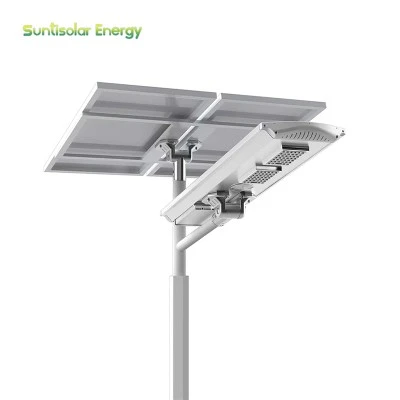
Suntisolar 60W Solar Street Light along urban road in La Union
Solar Street Lights in the Philippines: DPWH Standards and Project Guide
Solar street lighting is becoming a practical option for road projects in the Philippines, especially where grid connection is expensive, unreliable or difficult to extend. But a government road-lighting project is not simply a matter of choosing a lamp with a high wattage. The design has to fit the road, lighting criteria, solar resource, local weather, pole and foundation requirements, and contract documents.
For contractors and suppliers, the safest starting point is the project's approved plans and specifications. The Department of Public Works and Highways (DPWH) has issued guidance for solar-powered roadway lighting and revised its standard specification for Item 624 – Roadway Lighting. These documents provide a framework, but the exact requirements for a procurement must be checked against the latest bid documents, drawings, special provisions and instructions from the implementing office.

1. What DPWH standards should a project team check?
Two DPWH documents are especially useful when screening a national-road lighting opportunity:
DPWH Department Order No. 19, series of 2023: Guidelines and Standard Design Drawings for Solar-Powered Roadway Lighting Along National Roads. It approved the use of solar-powered roadway lighting and made standard drawings available as references for DPWH regional offices, district engineering offices, project-management units and consultants.
DPWH Department Order No. 26, series of 2023: Revised Standard Specification for Item 624 – Roadway Lighting. It sets out the general work scope and material requirements for roadway lighting, including solar-powered LED systems.
Which layout on which road
Layout depends on road class. Primary national roads can use single-side, axial, opposite or staggered. Secondary roads can use single, opposite or staggered. Tertiary roads can use single or staggered.

Figure 2. Layout options. Which ones you can use depends on road class (see DO 19).
Axial means poles in the median, so it only shows up on divided primary roads. For a plain two-lane road with no median you'll be choosing between single-side, opposite and staggered. Opposite roughly doubles the pole count compared with single-side at the same spacing, so it's usually kept for wider roads.
Pole height, wattage and spacing
This is where DO 19 Table 2, as amended by DO 48, earns its keep. It gives you road width, placing, mounting height, lamp wattage and mast-arm length by road class. A few rows, to give you a feel for it [3]:
|
Road class |
Layout |
Road width (m) |
Spacing (m) |
Mounting height (m) |
LED watts / arm (m) |
|
Primary |
Single |
13.4 |
15-35 |
12 |
80-125 / 3.0 |
|
Primary |
Opposite |
20.1 |
20-40 |
12 |
200-300 / 1.5 |
|
Secondary |
Single |
6.7 |
15-35 |
10 |
80-125 / 1.5 |
|
Secondary |
Single |
6.7 |
15-35 |
6 |
50-80 / 1.5 |
|
Secondary |
Staggered |
6.7 |
15-35 |
8 |
80-125 / 1.5 |
|
Tertiary |
Single or staggered |
5 or 6.1 |
10-25 |
8 |
50-80 / 1.5 |
|
Tertiary |
Single or staggered |
5 or 6.1 |
10-25 |
6 |
50-80 / 1.5 |
The practical point is important: do not assume that a generic solar street light datasheet automatically satisfies a DPWH project. Read the technical specifications line by line and prepare a compliance matrix. If a requirement is unclear or appears inconsistent with the project drawings, raise a formal clarification before submitting a bid.
Key Item 624 points to verify
The published DPWH Item 624 specification includes requirements such as the following. This is a preliminary summary, not a substitute for the official specification or project-specific amendments.
- Materials must be new and of approved type, and applicable Philippine Electrical Code requirements must be met. The document refers to PS marking for locally manufactured products and ICC certification marks for imported products.
- The specification identifies luminaire color-temperature ranges and states that warm white is to be used for primary roads.
- For solar-powered LED roadway lighting, the LED modules, PV modules, controllers and battery pack are described as independently replaceable components, with manufacturer or manufacturer-certified distributor warranty certificates indicating a minimum six-year warranty period.
- The LED luminaire is required to be suitable for outdoor use and rated IP65 under the cited specification.
- The battery requirement identifies a deep-cycle lithium-ion type and addresses service life, high-temperature performance, and battery temperature/charging/discharging protection.
Tender documents may include additional technical schedules, drawings, testing procedures, installation details or special provisions. Confirm the exact revision and applicability for each procurement. A blog post is not the controlling contract document.
2. Start with the road, not the product wattage
A 60 W light that works well on a narrow barangay access road may be unsuitable for a wide, busy arterial road. Conversely, installing a high-output fixture everywhere can waste money if the optics, pole height and spacing are wrong.
Before selecting a luminaire, collect the following project information:
- Road classification and location: national highway, urban arterial, secondary road, rural road, bridge approach, intersection or pedestrian area.
- Road geometry: carriageway width, number of lanes, median, shoulders, sidewalks, curves, junctions and roadside obstacles.
- Lighting requirements: applicable DPWH criteria and referenced roadway-lighting standards; target illuminance or luminance; uniformity; glare and spill-light limits.
- Pole arrangement: mounting height, outreach, single-side, opposite-side, staggered or median installation, and proposed spacing.
- Operating profile: required hours each night, whether dimming is permitted, and whether full output must be maintained throughout the night.
- Site conditions: tree shade, nearby buildings, salt spray, dust, flooding, wind exposure, access for maintenance and risk of vandalism.
- Solar resource: location-specific monthly solar radiation, especially the cloudier and rainier months.
For roadway lighting, simulation should use the real road geometry and the selected luminaire's photometric file (IES or LDT), not just the advertised lumen figure. DIALux or equivalent calculations can assess average illuminance or luminance, uniformity and the likely effect of pole spacing. Use the criteria stated in the project documents rather than choosing a target after seeing which fixture performs best.
3. Design for Philippine weather, especially the rainy season
The Philippines has strong solar potential, but solar availability is not the same at every site or in every month. A system sized from annual-average sunshine alone can be under-designed for the months when cloud cover and rainfall reduce charging. Island geography, local weather patterns, nearby mountains, tree cover and urban shading can all affect the energy a panel actually collects.
For each candidate site, review monthly solar-radiation data and use a conservative design-month value. NASA POWER and the European Commission's PVGIS are useful starting points for resource screening; for final design, confirm that the dataset and geographic resolution are appropriate for the project location.
Battery autonomy should be tied to required operating reliability and the project specification. A requirement for several consecutive rainy days is not interchangeable with a guaranteed number of nights at full output unless the battery, load profile and assumptions support it. Account for usable battery capacity, temperature, conversion losses, aging and the lighting control profile.
4. What should a solar roadway-lighting specification cover?
A complete system is more than a lamp and panel. Review the following as a coordinated package:
- LED luminaire and optics: photometric distribution, rated input power, maintained light output, color temperature, glare control and applicable IP rating.
- PV module: rated power, dimensions, mounting arrangement, mechanical loading and resistance to the local environment.
- Battery pack: chemistry, nominal voltage and capacity, usable energy, protection, temperature management, serviceability and warranty.
- Controller: charging strategy, low-voltage protection, dusk-to-dawn operation, programmable dimming, fault behavior and required monitoring.
- Pole, bracket and foundation: material, corrosion protection, structural design, wind loading, anchor bolts, concrete footing and grounding.
- Cabling and protection: cable sizing, connectors, surge protection, earthing/grounding and safe isolation for maintenance.
- Documentation: datasheets, photometric files, drawings, calculation reports, test reports, certificates, warranty statements and O&M instructions.
Where a project requires a self-cleaning panel, confirm that the requirement is explicit or accepted by the engineer. Self-cleaning can help where dust, sea spray or other deposits reduce PV output, but it does not replace correct panel orientation, inspection or sizing for low-sun months.
5. Real project examples: how the requirements can differ
The following examples are based on publicly available DPWH project documents and published research. They show how a specification should be read; they are not a claim that one design fits every Philippine road.
Example A - DPWH solar street-light plan showing a 150 W system
A publicly accessible DPWH plan set includes a solar street-light schedule describing a 150 W LED fixture, a 160 W monocrystalline PV module, a 25.6 V LiFePO₄ battery with a stated capacity, at least 20,000 lm output, 12 hours of lighting, a 10–12 m mounting height, IP66 or higher protection and a stated rainy-day operating target. The drawing set also includes a roadway cross-section and project-specific pole arrangement.
The lesson is not to copy those values into every proposal. Read the complete package together: lamp output, battery energy, PV capacity, mounting height, road geometry and autonomy must make sense as one system. The approved drawings and specification for the new project take precedence.
Example B - Daang Maharlika project drawing in Tacloban
A publicly posted DPWH plan set identifies a solar LED street-light installation along Daang Maharlika (S00013LT) in Tacloban City, with project coverage of approximately 0.620 km. It illustrates the kind of drawing package used for public works: location and vicinity maps, general notes, quantities, typical cross-sections, foundation details and a roadway-lighting layout.
For a bidder, this is a reminder that the engineering deliverable is not just the luminaire datasheet. The proposal must coordinate with the road alignment, pole locations, foundation design, bill of quantities and installation details.
Example C - Research-backed integrated design
Rabaza Castillo and colleagues' 2025 open-access paper developed a comprehensive design model for photovoltaic public lighting in rural and urban areas. It considers street width, required average illuminance, solar irradiance, luminaire characteristics, pole distribution, mounting height, battery capacity and PV power in one process. Its Oman case study supports a practical point for Philippine projects too: choosing a lower-wattage lamp does not automatically reduce total system cost or energy use if layout and energy design are not considered together.
6. Worked screening example for a rural road
Suppose a local road project requires a standalone solar light to operate for 12 hours each night. For an initial energy screen, assume a 60 W luminaire runs at full output for 5 hours and at 50% output for the remaining 7 hours. The nightly LED energy is:
E = (60 W × 5 h) + (30 W × 7 h) = 510 Wh per night
This is only the lighting load. The final design must include controller and conversion losses, usable battery capacity, aging allowance and the project's autonomy requirement. If the tender does not permit dimming, calculate the load using the required full-output operating profile.
For a rough PV screening calculation, divide daily energy demand by design-month peak-sun-hours and an overall system-efficiency factor. State the assumptions and verify the final panel size against local monthly solar data and the battery-recovery requirement. One annual-average sunshine figure is not enough for a reliability-critical road.
7. How Suntisolar products can fit into a DPWH-oriented proposal
Suntisolar's all-in-one solar street lights design is designed as the standard of DPWH guideline. Its product range from 60W 80W 120W 150W Solar Street Lights are largely used for DPWH projects in areas like Ilocos Norte, Alaminos Pangasinan, La Union, Mindanao, Laoag, Tacloban, Cagayan, Manila....
- For a narrow rural road or community access road, a compact all-in-one model 60W may be evaluated if the photometric calculation and energy budget meet the criteria.
- For Urban roads, 120W is mostly used.
- For express way, the 150W and above models are more suitable to do the calculation.
- For DPWH procurement, provide model-specific evidence: IES/LDT file, photometric report, PV and battery specifications, controller behavior, IP rating, warranty, mechanical drawings and required certificates. Do not rely on a family-level catalogue page alone.
8. A practical pre-bid checklist
- Confirm the latest DPWH order, Item 624 specification, project plans and special provisions.
- Build a clause-by-clause compliance matrix; identify every deviation before bid submission.
- Confirm road class, geometry, lighting criteria, pole height and spacing.
- Run photometric calculations with the actual IES/LDT file and project layout.
- Size PV and battery using location-specific monthly solar data and the required rainy-day autonomy.
- Check pole and foundation design for local wind exposure, corrosion and site conditions.
- Confirm battery chemistry, replaceability, protection and warranty terms.
- Prepare datasheets, photometric reports, electrical diagrams, structural drawings, certificates and O&M documents.
- Confirm contractor responsibilities for installation, testing, commissioning and replacement during the warranty period.
- Request written clarification for ambiguous or conflicting requirements rather than making assumptions.
Conclusion
A good solar street-light proposal for the Philippines begins with the road and the contract, not with a catalogue wattage. DPWH Department Order No. 19, series of 2023, provides guidance and standard drawings for solar-powered roadway lighting along national roads, while Department Order No. 26, series of 2023, revises the Item 624 roadway-lighting specification. Both should be reviewed alongside the project's approved plans and special provisions.
The strongest proposal connects photometric design, PV and battery sizing, pole and foundation engineering, product documentation and a long-term maintenance plan. That is what helps a solar street-light system deliver dependable light through the Philippine rainy season-and helps a contractor submit a proposal that can be checked, approved and maintained.
Frequently asked questions
Is solar street lighting allowed on DPWH roads?
Yes. DO 19, s. 2023 approved solar-powered roadway lighting on national roads and issued standard design drawings .
Which DPWH document gives the material specs?
Item 624, Roadway Lighting, as revised by DO 26, s. 2023. Solar LED lighting is covered under 624.2.1 .
Can I use a 6 m pole?
On secondary and tertiary roads, yes. DO 48, s. 2023 added 6 m pole parameters to Table 2, with a 1.5 m mast arm tilted at 60 degrees so the luminary doesn't overhang the roadway.
What battery type does DPWH want?
Item 624 asks for a deep-cycle lithium-ion battery with insulation and temperature protection. LiFePO4 is a lithium-ion chemistry, but confirm with the procuring office if your bid documents are strict about wording.
Do imported lights need special marks?
Item 624 says imported products need an Import Commodity Clearance from the Bureau of Philippine Standards, and locally made ones need a PS mark.


