

A customer sends the same spec to five factories: 100 W, 12,000 lumens, LiFePO4 battery, IP67, five-year warranty. The quotes come back and the cheapest one is half the price of the most expensive. Sometimes less than half.
Both can't be right. Either the expensive one is padding, or the cheap one is hiding something. In most cases it's neither, and the answer is simpler: the two lights only share a spec sheet. What's inside is different.
This article walks through where those differences sit. Battery quality, LED components, optical design, and thermal management are often major contributors to solar street light price differences. However, solar panel specifications, controller functions, housing materials, and project requirements should also be considered when comparing supplier quotations.
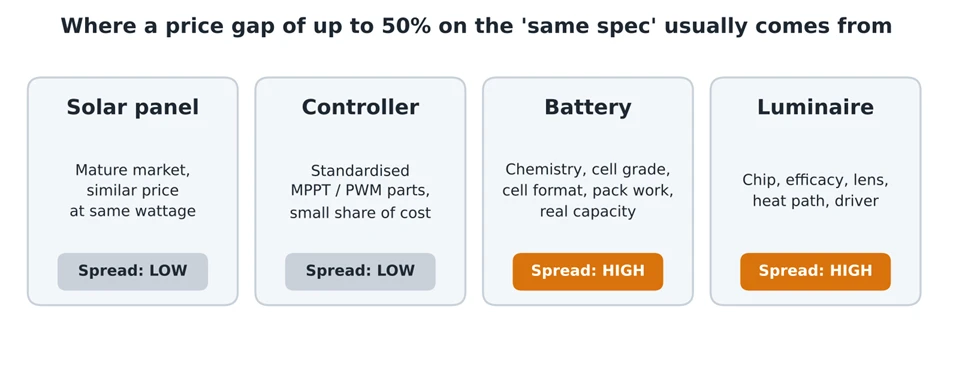
Figure 1. Where the price gap usually sits. Panel and controller are mature parts; battery and luminary have the room.
1. Why the same spec can mean different products
The main reason is plain: there is no international standard for a complete solar street light, such as how much real battery capacity a "100 W" light needs, how many nights it should run, or how well the LED must be cooled. If you know of one, treat this as a gap in my search, not in yours.
Without that, each factory decides what "100 W, 12,000 lm, LiFePO4" means. A spec sheet lists labels. It doesn't list the grade of the cells, the measured capacity, or the temperature at the LED board.
Some buyers have already noticed
Public tenders tend to write their own rules because nothing international does it for them. The Philippines' DPWH Item 624 (DO 26, s. 2023) asks for a deep-cycle lithium-ion battery with heat insulation and temperature protection, LM-80 and TM-21 reports for the LEDs, IEC 62471 photobiological safety, IP65 or better, and a six-year warranty on each replaceable component [7]. That list is useful for any buyer, not just government ones, because each line closes one of the gaps below.
A real example of the other extreme: a June 2024 request for quotation from the DPWH Cebu 3rd District Engineering Office asked for a solar streetlight with a 200 W monocrystalline panel, a 12.8 V 120 Ah battery and a three-year warranty [8]. Those are the numbers a bidder can match on paper. As far as I could see in the RFQ, it doesn't say which cell grade, which cell maker, or what capacity test the battery must pass. Two bids can tick every box and still be far apart in cost. This isn't a criticism of the office; a short purchase request can't carry a full specification. It just shows how easy it is for the paper to look the same.
2. Components That May Have Smaller Cost Differences
Solar panel. Monocrystalline panels at a given wattage come from a mature, competitive supply chain. A panel labeled 150 W is usually priced close to another 150 W panel. The difference worth checking is whether the wattage is real (a quick flash test or a measured Voc and Isc under sun), not the price.
For all-in-one solar street lights, some low-cost designs use smaller solar panels and compact aluminum housings to reduce material and manufacturing costs. Buyers should verify the actual panel wattage, dimensions, and charging performance rather than relying only on the stated specifications.
Controller. Most controllers are standard modules with a small share of the total cost. A better controller has real value, such as accurate charge termination and temperature-aware charging, but it won't make one light cost 40% more than another.
That leaves the battery and the luminary. Together they usually hold most of the cost, and most of the room for cutting corners.
3. The battery: Four ways to get a cheaper quote
3.1 Used cells and B-grade cells
This is the biggest trick, and the hardest to see. A battery pack can be built from new A-grade cells, from cells rejected at the factory for capacity or consistency (often called B-grade), or from cells taken out of retired electric vehicles or other packs. From outside, they look the same. All of them can be labeled "LiFePO4 25.6 V 60 Ah".
Researchers who tested retired cells found why this matters. A 2025 study measured 36 cells taken from three BMW i3 modules (94 Ah NMC prismatic cells, tested at 25 °C). These were good cells: the average capacity was about 95% of the rated 95.2 Ah. Even so, individual cells ranged from about 84.3 Ah to 94.2 Ah, a spread of around 10 Ah inside three modules, with one cell clearly degraded [2]. The authors caution that three modules is a small sample, so read it as a pattern rather than a rule.
Why does the spread matter? In a series string, the weakest cell sets the limit. When it is full, charging has to stop. When it is empty, the light has to stop. The rest of the capacity goes unused. That is why used or mixed-grade cells often disappoint after a few months, even if they tested well when new.
One caveat: the study used EV cells. It is evidence that retired cells vary a lot, not a measurement of any particular street light supplier.
3.2 Chemistry: LiFePO4 or Ternary lithium
LiFePO4 (LFP) cells have a nominal voltage around 3.2 V, so eight in series give the 25.6 V system common in solar street lights. Ternary (NMC/NCA) cells sit around 3.7 V, so seven in series give a "24 V" system. In general, LFP is favored for outdoor lighting because of its thermal stability and long cycle life, while ternary cells pack more energy into less volume. Price per Wh moves with raw materials, so the cheaper option changes from year to year.
3.3 Pack work and protection
Pack process covers the details that don't show on a label: cell matching before assembly, weld method, wire gauge, fusing, balancing, a protection board with proper overcharge, over-discharge, over-current and temperature cut-offs, and the enclosure. DPWH Item 624 asks for heat insulation and temperature sensing to protect charging and discharging [7], which is one reason to ask what the BMS does at high and low temperature.
3.4 Real capacity lower than the label
The last one is the simplest: the pack just has less capacity than the quote says. A 25.6 V pack's energy is volts times amp-hours. A 60 Ah pack holds 1,536 Wh. If the pack really contains 45 Ah of cells, it holds 1,152 Wh, 25% less. The light still switches on every night, so nobody notices until a run of cloudy days.
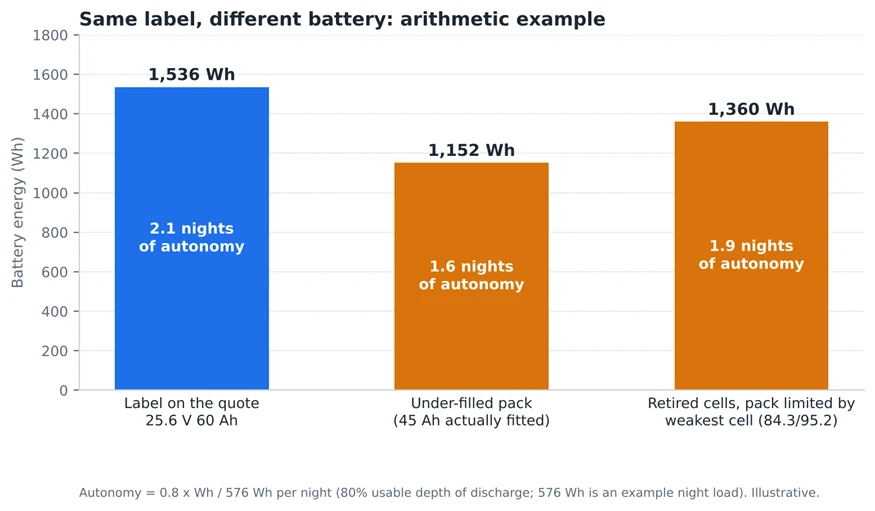
Figure 2. Arithmetic example: the same label with three different realities. Autonomy uses 80% usable depth of discharge and a 576 Wh/night load.
4. The luminary: what a spec sheet leaves out
4.1 Chip model: 3030 or 5050
3030 and 5050 are package sizes. 3030 is a 3.0 × 3.0 mm package and 5050 is 5.0 × 5.0 mm. The name tells you the footprint, not the quality. A 5050 from a major LED maker can outperform a 3030 from an unknown one, and the reverse is true too. What changes the price is the maker, the bin, the drive current, and whether the efficacy claim was measured at the current the light actually uses.
So "3030 chips" or "5050 chips" on a quote isn't enough. Ask for the exact chip part number, and ask for the LM-80 report for that part. LM-80 is the method for measuring how an LED source's light output declines over time. The LED Lighting Facts program asks for at least 6,000 hours of LM-80 data at several case temperatures [4]. Without those two reports, a lifetime claim is just a number.
4.2 Efficacy and lumens
Two lights can both say 12,000 lumens. One may be quoting the sum of the chip ratings, the other the lumens leaving the luminary. Light is lost in the lens and the cover, and chip efficacy is usually quoted at a lower current and a cooler temperature than the light really runs at. Ask which one the number is, and under what conditions it was measured.
4.3 Lens and distribution
The lens decides where the light goes. A road needs light spread along and across the carriageway with controlled glare, not a bright spot under the pole. The Smart All-in-One page lists beam angles of C0 to 180 at 140° and T90 to 270 at 70°, with an adjustable module angle of ±15° [11]. Ask for an IES file and run a lighting simulation (DIALux is common) for your pole height and spacing. Equal lumens with a poor distribution will light the road worse than fewer lumens with a good one.
4.4 Heat: the part that is easy to forget
Heat is where the quiet differences live. An LED turns most of its input power into heat rather than light. If that heat can't leave, the junction temperature rises, and light output decays faster.
This is not new. In a 2004 study of white LEDs, Narendran and colleagues found that the junction temperature had a much greater effect than the short-wavelength amplitude on degradation. Across junction temperatures of 69 °C to 115 °C, the decay constant increased exponentially with temperature, and much of the light loss came from yellowing of the encapsulant, which heat accelerates. Their conclusion was to extract heat from the die more efficiently to keep it cooler [3].
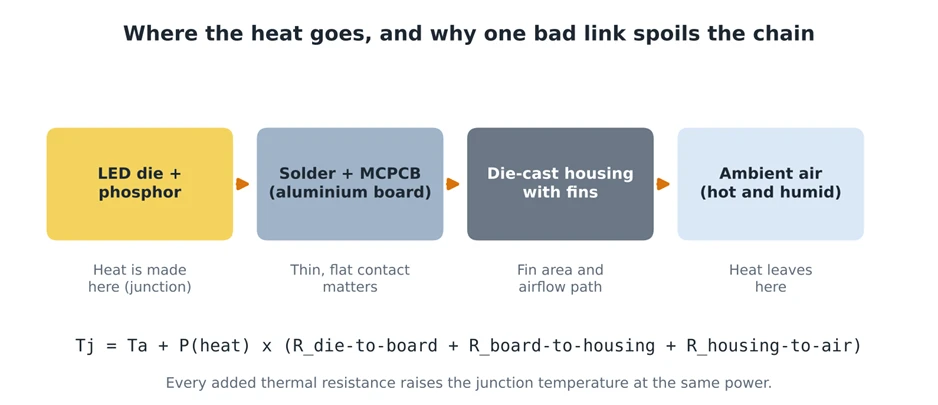
Figure 3. The heat path of an LED luminary. Any weak link raises the junction temperature at the same power.
In practice, the heat path is the board (usually aluminum), how the board is attached to the housing (flat contact, thermal interface), and the housing itself (die-cast aluminum, fin area, airflow). In an all-in-one light, there is one more problem: the battery and the LED sit in the same sun-heated body. Cheap designs save on aluminum, use thin housings, or skip the thermal interface, and none of that shows up in a lumen number.
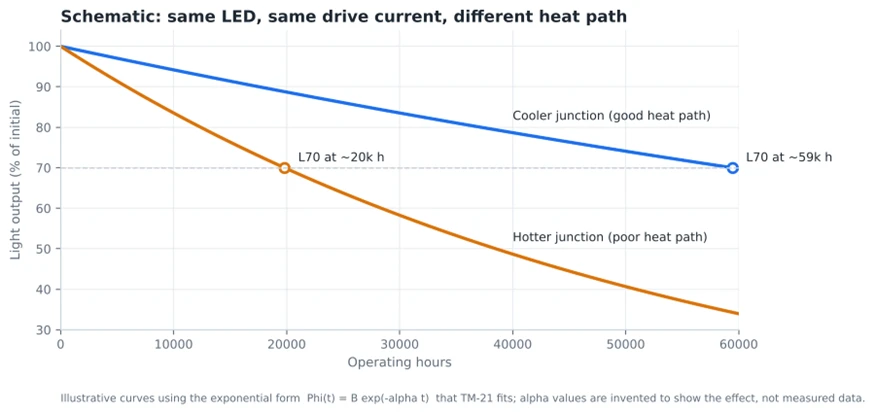
Figure 4. Schematic only: the same LED at the same current loses light faster when it runs hotter. Curves are illustrative.
5. How Three Solar Street Light Quotations Can Differ
The table below is a composite built from the patterns above. It isn't three real quotes, and the cells show how "the same spec" can hide different products.
|
Item |
Quote A (lowest) |
Quote B (middle) |
Quote C (highest) |
|
Battery cells |
Mixed or retired cells; origin not stated |
New cells, B-grade or unspecified grade |
New A-grade cells with datasheet and lot record |
|
Real capacity |
Not measured; may be below label |
Label capacity, no test report |
Measured on a sample pack and reported |
|
Pack work |
Thin strips, no balancing |
Basic protection board |
Matched cells, balancing, temperature cut-off |
|
LED chip |
Unnamed, unbinned |
Named maker, no LM-80 report |
Named part with LM-80 and TM-21 data |
|
Lens |
Generic, one distribution |
Standard distribution |
Distribution chosen for the road; IES file |
|
Thermal |
Thin housing, no data |
Adequate housing, no data |
Case temperature reported at full power |
|
Documents |
Generic certificate |
Certificates for parts |
Test reports for the pack and luminary |
Composite illustration of patterns described in the article, not real quotes. Replace the cells with what your own suppliers actually send.
Quote A can still turn the light on every night during the first season. The difference shows up later, as short autonomy in the wet months, dim light after a year or two, and a battery replacement the customer didn't budget for.
6. How to compare quotes properly
- Check Dimension and Weight. This can judge the basic calculation of Solar Panel, Battery and Luminary Quality.
- Ask for cell grade, battery voltage, dimension packing photos and weight. This can get a basic understanding of the battery quality.
- Measure a sample. Charge a sample pack fully, discharge it at a low rate to cut-off, and multiply amp-hours by the average voltage. Compare it with the label.
- Ask for LM-80 and LM79 Report. This can check real led chips lumen maintenance and lumen efficiency.
- Ask for heat radiation design picture and luminary weight. This can check the luminary thermal design.
- Check actual sample. The last step is to compare the real samples, check the details and open to check inside details.
Frequently asked questions
Why can two solar street lights with the same wattage be 50% apart in price?
Wattage and lumens describe output. They don't describe the battery cells, the real capacity, the chip, the lens or the heat design, which is where most of the cost and the difference sit.
Is there an international standard for solar street lights?
There are standards for the parts, such as IEC 60598-2-3 for luminarys [9], IEC 62133-2 for lithium cells and batteries [5] and LM-80 for LED sources [4]. But there is no Standard for a whole solar street light.
Is LiFePO4 always better than ternary lithium?
LiFePO4 is widely used for outdoor lighting for its stability and cycle life, specially for those high temperature area.
How can I check the real battery capacity?
Fully charge a sample pack, discharge it at a low constant current to the cut-off voltage, and multiply amp-hours by average voltage. .
Bottom line
When two quotes for the same spec are far apart, don't start by haggling. Start by asking what's inside. The battery cells and the luminary's chip, lens and heat path account for most of the difference, and a spec sheet shows none of them. Get the BOM, get the reports, measure a sample, and compare the lights you actually get. But still even for the documents, there are many fake documents.
The best way is to check the actual sample materials, opening it and check materials used inside, this will be easier to have a good understanding of the real quality.
This article is general information, not engineering or legal advice. Standards and product specifications change, so confirm current versions with the supplier before buying.
References
[1] Preger, Y., Barkholtz, H.M., Fresquez, A., et al. (2020). Degradation of Commercial Lithium-Ion Cells as a Function of Chemistry and Cycling Conditions. Journal of the Electrochemical Society, 167(12). https://www.osti.gov/pages/biblio/1650174
[2] Hassini, M., Mintsa-Eya, C., Redondo-Iglesias, E., Venet, P. (2025). Influence of Cell Position on the Capacity of Retired Batteries: Experimental and Statistical Studies. arXiv:2507.14020. https://arxiv.org/abs/2507.14020
[3] Narendran, N., Gu, Y., Freyssinier, J.P., Yu, H., Deng, L. (2004). Solid-state lighting: failure analysis of white LEDs. Journal of Crystal Growth, 268(3-4), 449-456. https://www.lrc.rpi.edu/programs/solidstate/pdf/narendran2004_jcrystalgrowth.pdf
[4] US DOE / LED Lighting Facts. LM-80 and TM-21 fact sheet (2012). https://www1.eere.energy.gov/buildings/publications/pdfs/ssl/west_facts_pittsburgh3012.pdf
[5] Battery Design. IEC 62133-2 summary (scope and tests). https://www.batterydesign.net/legislation-rules-and-regulations/iec-62133-2/
[6] Battery Design. Battery cell design: formats, chemistry and key metrics. https://www.batterydesign.net/battery-cell/
[7] DPWH (Philippines). Department Order No. 26, s. 2023: Revised Standard Specification for Item 624, Roadway Lighting. https://dpwh.gov.ph/DPWH/sites/default/files/issuances/do_026_s2023.pdf
[8] DPWH Cebu 3rd District Engineering Office. Request for Quotation, solar streetlight, June 2024. https://www.dpwh.gov.ph/dpwh/sites/default/files/webform/goods_and_services/advertisement/2024-06-0073_rfq_-_final.pdf
[9] IEC 60598-2-3: luminarys for road and street lighting (scope as listed by IECEE). https://www.iecee.org/certification/iec-standards/iec-60598-2-32002


