
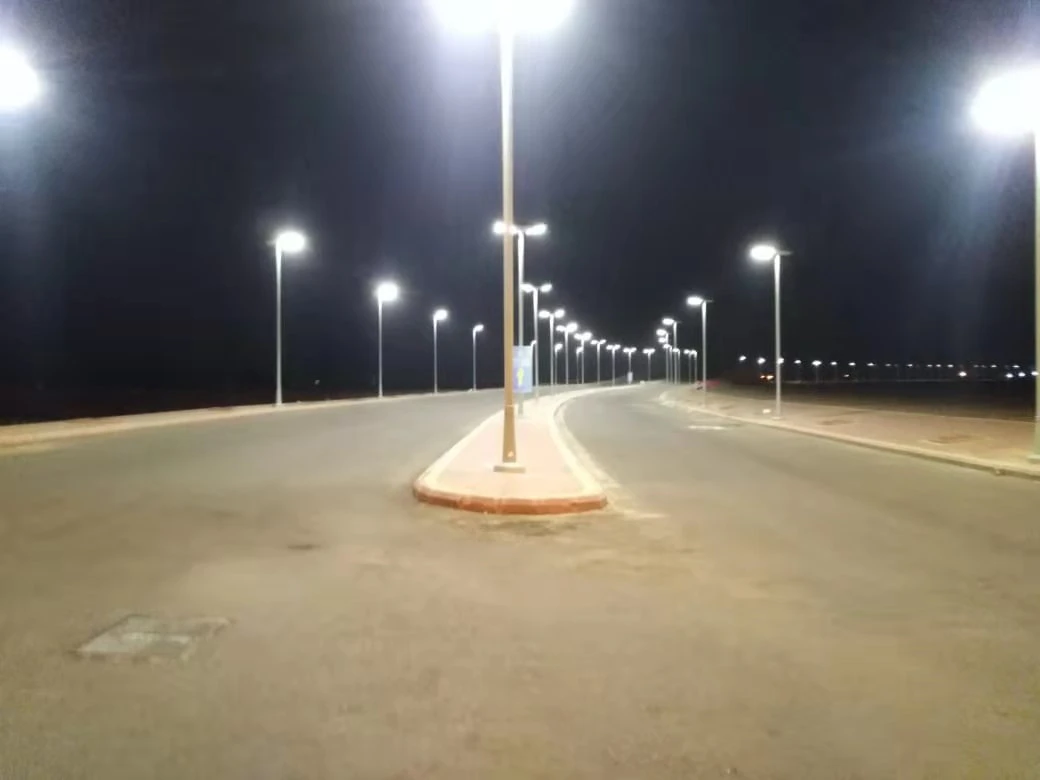
There is no single answer to how bright a street light should be. Whether a fixture is enough depends on three factors that together set your illuminance target: pole height, road class, and pole spacing. For a solar street light, there is one more layer - the solar panel must generate enough power, and the battery must carry the load through cloudy and rainy days.
Yantai Xutai New Energy (Suntisolar) designs and manufactures solar street lights for government-grade projects. This guide looks at selection from its perspective: a directly usable lumens-vs-pole-height chart, plus the extra engineering checks solar lighting demands.
01 Lumens, Pole Height and Illuminance: Three Concepts First
To read the chart, start with three metrics:
- Lumen (lm) - the total light output of the fixture; how much light it emits.
- Illuminance (lux) - the light that reaches the road surface per unit area; how bright the road is.
- Mounting height (m) - the installation height, which sets coverage and fall-off.
They are connected by the inverse-square law: for the same road and fixture, raising the pole from 8 m to 10 m cuts road illuminance by about 36%, because (8÷10)² ≈ 0.64. The higher the pole, the more lumens you need for the same brightness. This holds for solar lights too - and with a bigger consequence: more lumens means more energy, hence a larger solar panel and battery.
02 The Core: A "Lumens vs. Pole Height" Chart
Here is the takeaway: the pole height sets the lumen order of magnitude; the road class sets the upper and lower end of the range. The table below gives typical engineering ranges for LED street lights, compiled from IESNA RP-8 and EN 13201 experience values. Suntisolar sizes its power tiers from this, with DIALux simulation as the final check.
|
Pole Height |
Typical Application |
Lumens · Low Traffic |
Lumens · High Traffic |
LED Power (Ref.) |
|
3 m |
Courtyards, garden paths, bike tracks |
1,500–3,000 lm |
- |
15–30 W |
|
4 m |
Garden paths, small parking lots |
1,500–3,500 lm |
2,500–3,500 lm |
20–35 W |
|
5 m |
Residential local roads |
2,000–3,500 lm |
3,500–5,000 lm |
30–50 W |
|
6 m |
Residential areas, collector roads |
3,000–5,000 lm |
5,000–7,000 lm |
50–70 W |
|
7 m |
Community distributor roads |
4,000–6,500 lm |
6,500–9,000 lm |
60–90 W |
|
8 m |
Collector roads, commercial streets |
5,000–8,000 lm |
8,000–11,000 lm |
80–110 W |
|
9 m |
Arterial roads |
9,000–13,000 lm |
13,000–18,000 lm |
100–150 W |
|
10 m |
Arterials, large intersections |
10,000–15,000 lm |
15,000–20,000 lm |
120–160 W |
|
12 m |
Expressways, elevated roads |
16,000–24,000 lm |
24,000–40,000 lm |
160–250 W |
|
15 m |
Highways, high-mast lighting |
25,000–35,000 lm |
35,000–60,000 lm |
250–400 W |
"Low traffic" covers residential and distributor scenarios; "high traffic" covers arterials and expressways. At the same pole height, wider pole spacing and wider road surfaces require more lumens. Power figures assume typical LED efficacy of about 140–160 lm/W and are order-of-magnitude references only.
03 The Extra Math for Solar: Beyond Lumens, Check Three Things
Lumens define the light, but a solar street light is a full "generate-store-light" system. From Suntisolar's engineering experience with all-in-one solar street lights, three things decide whether a project stays on:
PV generation. More lumens and longer operation mean higher daily energy use, which needs a larger monocrystalline panel. Suntisolar uses grade-A monocrystalline modules with >16% conversion efficiency, plus time-segment dimming to optimize system cost.
Battery capacity. A LiFePO₄ (lithium iron phosphate) battery delivers long cycle life, high-temperature tolerance and better safety. Capacity is sized for 3–5 days of autonomy through consecutive cloudy/rainy days, so the road does not go dark in the wet season.
Structure and protection. IP66 waterproofing, typhoon-resistant construction (withstanding about wind level 12) and a die-cast aluminum housing keep the light reliable for years in desert, coastal and windy regions.
In short: the chart decides how bright the light is; the PV and battery decide whether it stays on.

04 Road Classes Set the Target
The chart is only the starting point; the real design rule is the lighting class. EN 13201 groups road lighting into three scenarios:
- Motor vehicle lanes M1–M6 - luminance-based; M1 averages 2.0 cd/m², M6 just 0.30 cd/m².
- Conflict and intersection areas C0–C5 - illuminance-based; C0 requires 50 lux minimum maintained, C5 just 7.5 lux.
- Footpaths and cycle tracks P1–P6 - average illuminance from 15 lux (P1) to 2.0 lux (P6), also covering minimum vertical illuminance and facial recognition.
Projects in China commonly follow CJJ 45 and GB/T 31832. The higher the class, the stricter the average luminance, uniformity and glare limits - and the higher the lumens required.
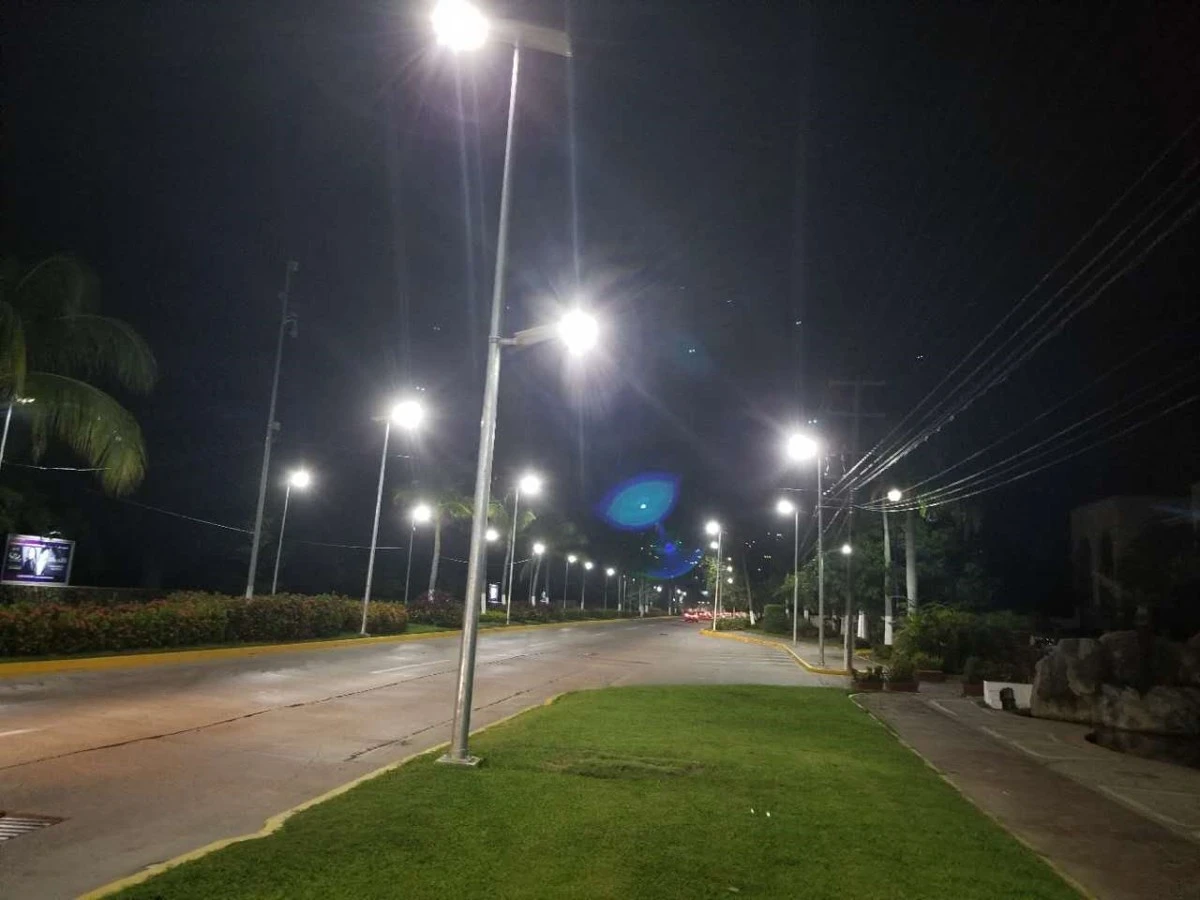
05 Verifying Solar Street Lights with DIALux
The chart gives an estimate; compliant delivery requires simulation. DIALux evo offers a dedicated road-lighting workflow:
- Set the lighting class (for example M4 collector or C2 intersection) and the road cross-section.
- Import the luminaire IES photometric file - light distribution, color temperature and efficacy.
- Arrange poles: mounting height 6–15 m, spacing usually ≤ 3× the pole height, tightened by 20–30% on curves.
- Check and verify: average luminance, overall uniformity Uo, longitudinal uniformity Ul and threshold increment TI.
- Adjust spacing, height, tilt and distribution, then output a compliant report and layout.
For off-grid solar lights, add one more step after simulation: back-calculate panel power and battery capacity from local peak sun hours, then check autonomy. Suntisolar's flow is "simulation sets the luminaire, sunshine sets the power source" - both are delivered together, so you never end up with "target illuminance met, but the light cannot survive the rainy season."
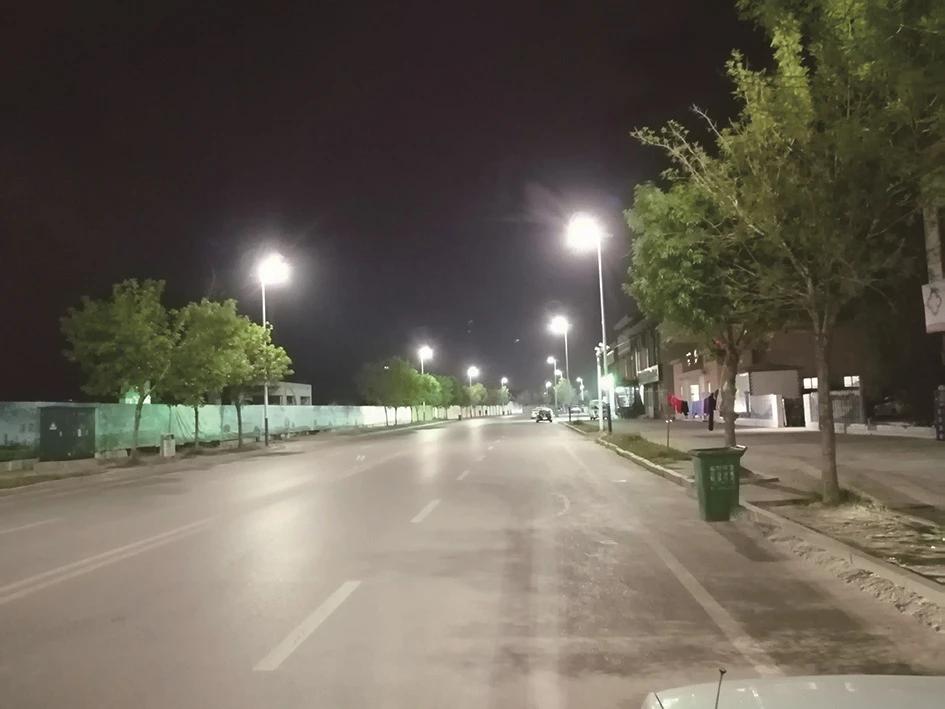
06 Selection Pitfalls and Engineering Advice
- Pitfall 1: "A lower pole can use a smaller light." Wrong - a 4 m pole loaded with a 100 W light causes glare and fails the class.
- Pitfall 2: "Only watts matter." With LED efficacy of 140–160 lm/W, the same wattage can differ by about 20% in lumens; choose by lumens.
- Advice 1: Close the loop in four steps - road class sets the target → pole height sets the lumen tier → DIALux simulation → sunshine-based PV and battery sizing.
- Advice 2: Put autonomy days in the contract. Suntisolar backs government projects with a 6-year warranty and a verifiable configuration checklist.
- Advice 3: Choose color temperature (3000K / 4000K / 6500K) deliberately; in hot-humid, coastal or windy regions, prefer IP66 plus typhoon-resistant construction.
There is no "guess" in street-lighting design. For solar street lights, the correct order is: road class sets the target → pole height sets the lumen tier → DIALux simulation sets the luminaire → local sunshine sets the PV and battery. Suntisolar turns this chain into a government-grade delivery standard - energy-efficient, compliant and easy to hand over.