

A complete buyer's guide comparing design, performance, cost, and ideal use cases for both solar street light types.
Solar street lights have become the go-to lighting solution for roads like Highway&Express Way, Urban Roads, Rural Roads, Community, Industrial and parking..., where grid power is expensive or unavailable. But once you start searching solar street light, you'll quickly run into two very different designs: All In One (also called "integrated") solar street lights and split-type (also called "separated") solar street lights.


Both use the same basic technology - a solar panel, battery, LED fixture, and charge controller - but how those components are arranged changes everything from installation time to long-term performance. This guide breaks down exactly how each type works, where each one shines, and how to decide which is right for your project.
What Is an All In One Solar Street Light?
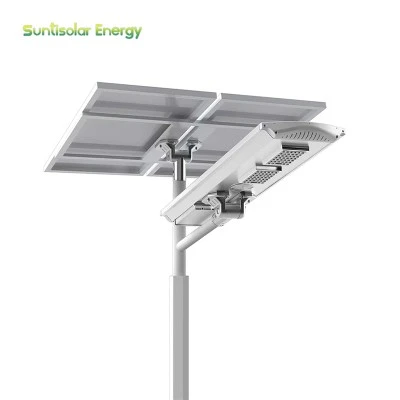
An All In One solar street light combines the solar panel, LED chips, lithium battery and charge controller into a single compact housing mounted at the top of the pole. There are no loose wires between components because everything is sealed inside one unit.

Figure 1: Anatomy of an All In One solar street light - every core component is built into a single head unit.
Key Characteristics
- Single-piece head unit that mounts directly to the pole arm
- Solar panel is angled and built into or onto the housing
- Battery (usually LiFePO4) is housed inside or directly behind the head unit
- Fast to install - often a single bracket and bolt connection
- Available across a wide range of wattages, from compact pathway lights to high-output road lights
A common misconception is that All In One lights are limited to small, low-power applications. That's no longer accurate. Manufacturers now build high-power All In One units with the same panel size and battery capacity you'd typically find on a split-type system - they just package it all into one head.
|
Real-World Example: Suntisolar 240W All In One Solar Street Light Suntisolar's 240W All In One model pairs a 340W monocrystalline solar panel with a 25.6V 90Ah LiFePO4 battery (roughly 2,304Wh of storage) - all integrated into a single head unit. LED Power: 240W Solar Panel: 340W monocrystalline Battery: 25.6V 90Ah LiFePO4 (≈2,304Wh) Housing: All In One integrated head That panel size and battery capacity sit well within the range typically associated with split-type systems, which shows that "All In One" describes how a light is built, not how powerful it can be. |
What Is a Split-Type Solar Street Light?
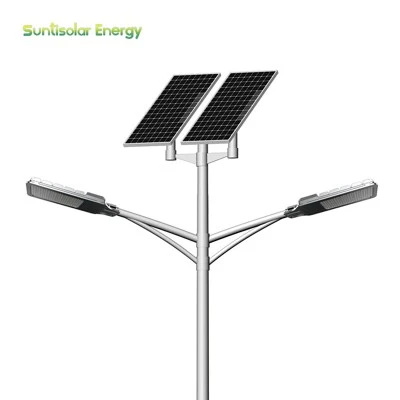
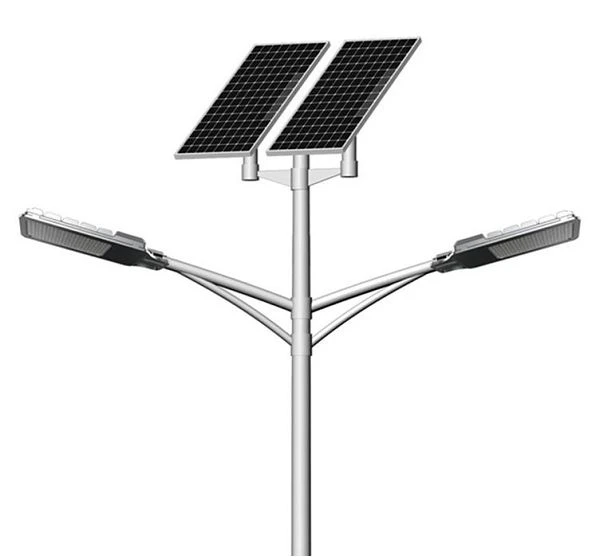
A split-type (separated) solar street light keeps the solar panel, battery box, and LED light head as independent components. They're connected by cables and mounted at different points on the pole - the panel sits where it gets the most sun, the battery is housed lower on the pole for easy access, and the light head is positioned for optimal road coverage.

Figure 2: A split-type system separates the panel, battery box, and light head, connected by weatherproof cabling.
Key Characteristics
- Components can be positioned independently for best performance
- Solar panel angle can be adjusted separately from the light head
- Battery box is externally mounted and easier to access for maintenance or replacement
- Often used for higher-wattage installations, though high-power All In One models now exist too
- Installation takes longer due to multiple mounting points and cable runs
All In One vs. Split-Type: Side-by-Side Comparison
Here's how the two designs stack up across the factors that matter most when planning a lighting project.
Detailed comparison table:
|
Factor |
All In One |
Split-Type |
|
Design |
Single integrated unit |
Separate panel, battery, light head |
|
Installation time |
Fast (single mount point) |
Slower (multiple mount points + wiring) |
|
Available wattage |
Entry-level through high-power (depends on manufacturer) |
Entry-level through high-power (depends on manufacturer) |
|
Battery type |
Usually LiFePO4, sealed inside |
LiFePO4 or lead-acid, external box |
|
Battery replacement |
Depends on model - some sealed, some serviceable |
Generally easy - accessible box on pole |
|
Solar panel angle |
Often fixed, though some models allow adjustment |
Independently adjustable for max sun |
|
Upfront cost |
Often lower at equal wattage |
Often higher at equal wattage |
|
Best climate |
Good for most regions if sized correctly |
Good for most regions if sized correctly |
|
Aesthetic |
Sleek, compact, modern |
Bulkier, more visible hardware |
Advantage and Disadvantage of Each Type
All In One: Advantage
•Quick, low-labor installation - ideal for large rollouts
•Sleek, modern appearance with no visible wiring
•Sealed design reduces exposure to dust and moisture
•Battery Not easily be stolen which a big headache for some countries
•Optional Self Cleaning function saves maintenance cost and keeps high charging efficiency
All In One: Disadvantage
•Panel angle is not as flexible as separate one, which can influence the charging efficiency in high attitude area
Split-Type: Advantage
•Independent panel positioning is more flexible for solar panel angle to get more sunlight and charging, especially in tricky locations
•Battery box is field-serviceable, simplifying long-term maintenance
•Panel and light head can face different directions if the site requires it
Split-Type: Disadvantage
•Longer installation time and more hardware to mount
•More visible components and cabling on the pole
•Battery easily be stolen
•Solar Panel cleaning maintenance cost is high
Which One Should You Choose?
Since both designs are now available across the full wattage spectrum, the decision comes down less to "how much power do I need" and more to installation priorities, maintenance plans, and site-specific factors.
Choose All In One If:
•You want the fastest possible installation across many poles
•You prefer a clean, compact look with no visible wiring or external boxes
•Your site has good, fairly direct sun exposure at the mounting height
•You're equipping residential streets, pathways, parking lots - or a high-power road project, using a high-output All In One model
Choose Split-Type If:
•Your position is high latitude, the solar panel installation angle must be over 20 degrees.
•Visible, modular hardware on the pole isn't a concern for the project
Frequently Asked Questions
Q: Is an All In One solar street light less reliable than a split-type?
A: Not necessarily. Reliability depends more on component quality (battery chemistry, LED driver, IP rating) than on the design type. All In One units are highly reliable for their intended wattage range and are widely used in commercial and municipal projects worldwide.
Q: Are All In One solar street lights only suitable for low-power applications?
A: No. While many All In One models are designed for residential or pathway lighting, manufacturers also build high-power integrated units. For example, Suntisolar's 240W All In One model uses a 340W solar panel and a 25.6V 90Ah LiFePO4 battery - specs comparable to many split-type systems. Always check the data sheet rather than assuming based on form factor alone.
Q: Can I upgrade an All In One light to a higher wattage later?
A: Usually not after installation, since the panel, battery, and LED are matched and built into one sealed unit. If you anticipate growing power needs, either choose a split-type system for future flexibility, or select an All In One model that's already sized for your peak requirement.
Q: Which type performs better in winter or cloudy climates?
A: Performance in low-sun conditions depends on panel size and battery capacity, not on whether the design is All In One or split-type. A high-capacity All In One unit, like one with a 340W panel and 90Ah battery, can perform as well in cloudy conditions as a similarly spec of split-type system. Compare the actual panel wattage and battery Ah rating, not the form factor.
Q: Do both types use the same kind of battery?
A: Most modern solar street lights of both types use LiFePO4 (lithium iron phosphate) batteries due to their long cycle life and safety profile. The key difference is accessibility - sealed inside the housing for All In One units, and externally mounted in a serviceable box for split-type units.
Final Thoughts
Both All In One and split-type solar street lights rely on the same core solar lighting technology - the real difference is architectural, not how powerful the light can be. All In One units, including high-output models like Suntisolar's 240W unit with its 340W panel and 90Ah battery, now cover the same performance range as many split-type systems. All In One wins on installation speed, a clean look, and simplicity. Split-type wins on flexibility to reposition or upgrade components independently.
When comparing two specific products, look past the "All In One vs. split" label and compare the actual panel wattage, battery capacity (Ah and voltage), LED wattage, and IP rating side by side. Those numbers - not the form factor - determine how a light will actually perform on your project.


